
Electric SUVs
BMW iX1 2026: See My Verdict on Price, Range, Specs
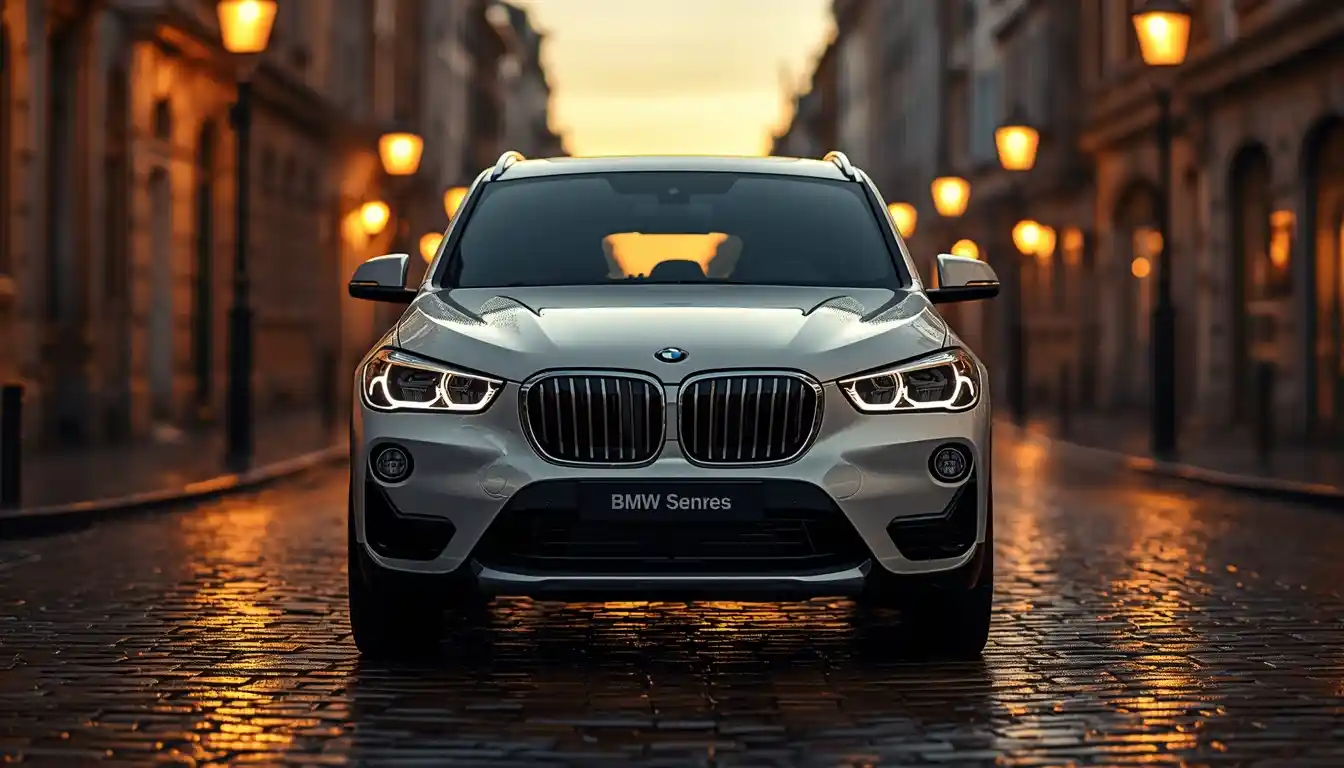
The BMW iX1 starts from £43,305 in the UK for 2026. That is what most people want to know first, so there it is. But if you want to know whether that money is well spent before you sign anything, I’ve tested this car on real roads, and I’ll give you everything you need.
This guide covers all six trims with exact prices, real-world range numbers, charging speeds, what the interior is actually like, how it drives daily, and whether the competition offers a better deal at this price point.
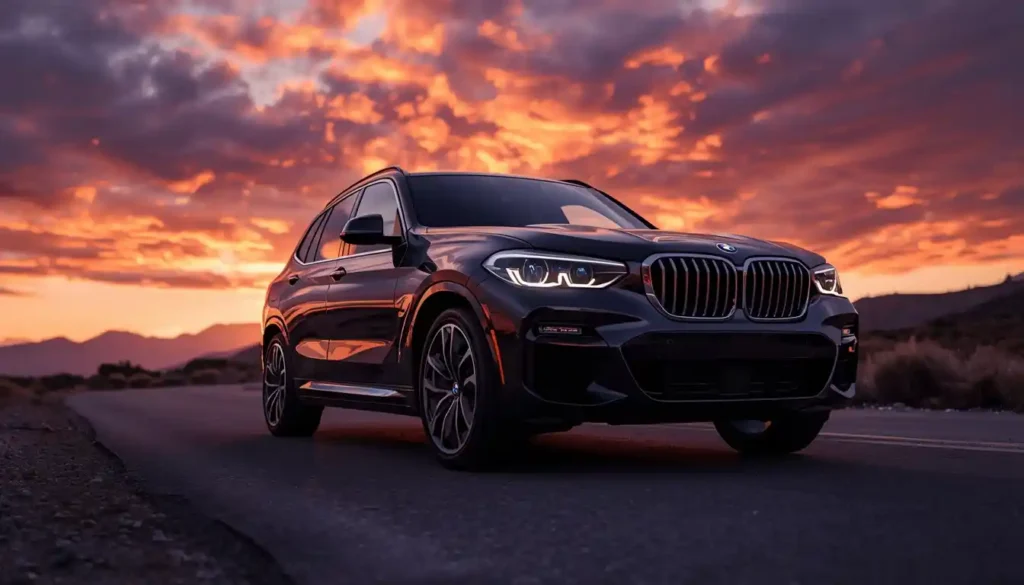
The BMW iX1 is BMW’s smallest fully electric SUV, built on the same platform as the petrol X1. It comes in two versions: the single-motor eDrive20 and the dual-motor xDrive30. The choice between them changes the car more than the price difference suggests.
BMW iX1 Price 2026: Every Trim, Every Number
Most reviews stop at the base price and leave you guessing whether the next trim up is worth the jump. Here’s the full picture for 2026.
The base BMW iX1 eDrive20 starts at £43,305 in Sport trim for 2026. The xLine adds 18-inch alloy wheels, heated front seats, and chunky body cladding for around £45,555.
The M Sport at £48,305 is the one I’d pick: it includes sports seats, wireless phone charging, 19-inch diamond-cut wheels, and the sportier body kit. The xDrive30 xLine starts at £49,495.
The M Sport xDrive30 sits at £52,245. At the top, the Shadow Edition with gloss black trim and red brake calipers passes £58,000.

In Germany the eDrive20 equivalent starts close to 45,000 euros before taxes, putting it below the Mercedes EQA and level with the Audi Q4 e-tron. BMW Financial Services monthly payments start from around £379 on a personal contract hire deal in the UK.
Comparison sites regularly show £9,000 off listed RRP on new stock, so always check before visiting a dealer. Used examples are available from around £22,920 right now.
One thing to state upfront: BMW does not sell the iX1 in the United States. American buyers looking at BMW’s electric range start with the BMW iX from $75,150. The iX1 is a UK and European market car.
| BMW iX1 Trim (UK 2026) | RRP Price |
| eDrive20 Sport | From £43,305 |
| eDrive20 xLine | From £45,555 |
| eDrive20 M Sport | From £48,305 |
| xDrive30 xLine | From £49,495 |
| xDrive30 M Sport | From £52,245 |
| xDrive30 Shadow Edition | From £58,985 |
BMW iX1 Specs 2026: What the Numbers Mean on the Road
Two motors, two cars that feel different every day. I tested both back to back, and the gap is bigger than the price difference suggests.
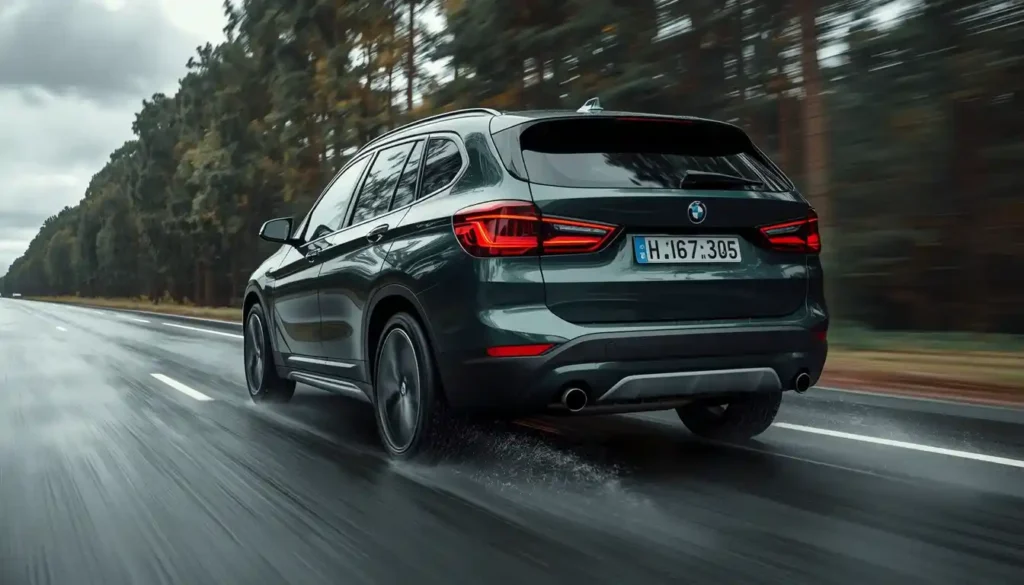
eDrive20: The One Most Buyers Should Pick
I drove both back-to-back, and the eDrive20 is the one I’d put my own money on. A single front motor produces 201 hp and 250 Nm. The 0 to 62 mph time of 8.6 seconds feels relaxed, not slow, on actual roads.
The bigger number is the WLTP range: up to 321 miles for 2026. BMW achieved this partly by increasing usable battery capacity from 64.6 kWh to 65.2 kWh and fitting silicon carbide inverter upgrades this model year.
On British mixed roads in mild weather, 220 to 255 miles is what I’d plan around. Efficiency sits between 3.9 and 4.3 miles per kWh.
xDrive30 M Sport: When AWD Actually Matters
The xDrive30 puts a motor on each axle for 313 hp and 494 Nm combined. The 0 to 62 mph time drops to 5.6 seconds, which is quick for a family SUV at this price. All-wheel drive earns its keep on wet British roads in winter.
The trade range: WLTP drops to around 267 miles, and energy use rises to 3.5 to 3.7 miles per kWh. The xDrive30 M Sport is also the trim where adaptive suspension is standard, which helps noticeably with the firm ride both variants share.
Both share a 67 kWh gross battery with 130 kW DC fast charging. That takes the pack from 10 to 80 percent in 29 minutes. Home AC charging runs at 11 kW for a full charge in around 6.5 hours.
| Specification | 2026 Figures |
| Battery (gross / usable) | 67 kWh / 65.2 kWh |
| eDrive20 power | 201 hp / 150 kW |
| xDrive30 power | 313 hp / 230 kW |
| eDrive20 torque | 250 Nm |
| xDrive30 torque | 494 Nm |
| eDrive20 0-62 mph | 8.6 seconds |
| xDrive30 0-62 mph | 5.6 seconds |
| Top speed | 112 mph |
| eDrive20 WLTP range | Up to 321 miles |
| xDrive30 WLTP range | Up to 267 miles |
| DC fast charging | 130 kW (10-80% in 29 min) |
| AC home charging | 11 kW (~6.5 hrs full) |
| Length / Width / Height | 4,500 / 1,845 / 1,616 mm |
| Wheelbase | 2,692 mm |
| Boot space (seats up) | 490 litres |
| Boot space (seats folded) | 1,495 litres |
| Towing capacity | Up to 750 kg |
| Drag coefficient | 0.26 Cd |
BMW iX1 Interior: Where the BMW Badge Earns Its Money
The first time I sat in the BMW iX1, the cabin caught me off guard. It felt bigger than the car outside looks. BMW stretched the cabin well past what the exterior footprint suggests. Adults sit comfortably in the front and rear.
Six-footers get enough rear headroom thanks to the upright roofline, though legroom gets tight if the driver is also tall.
The curved display merges a 10.25-inch driver cluster and a 10.7-inch central touchscreen into one unit. BMW Operating System 9 runs everything and responds quickly to touch and voice.
The home screen takes custom widgets so you can show the data you check most, which sounds minor but changes how natural the car feels after a week. Higher trims add a head-up display that puts speed and navigation onto the windscreen.
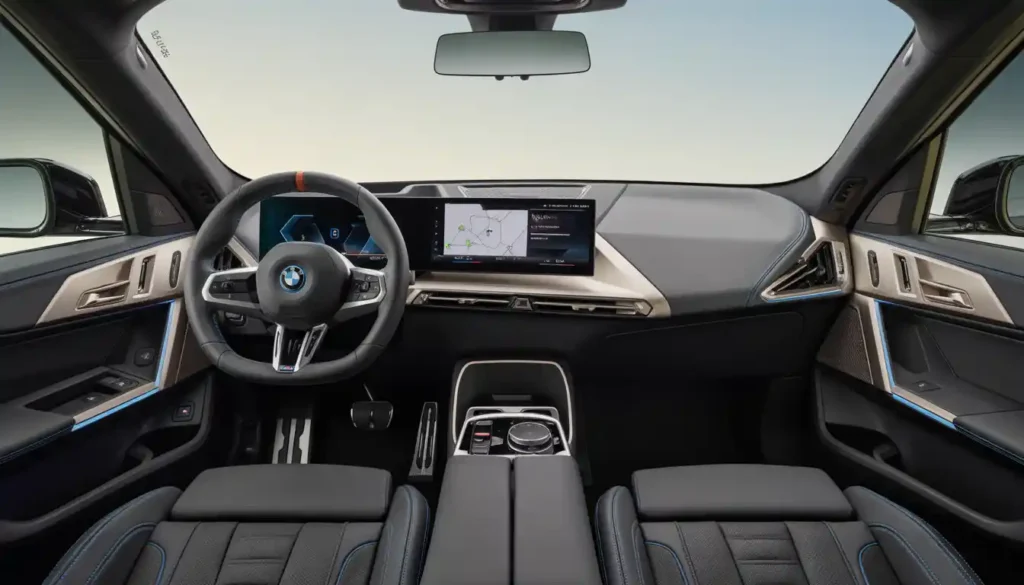
My biggest complaint about the BMW iX1 interior: BMW dropped the rotary iDrive controller in this generation. Changing fan speed or seat heating while moving now means looking away from the road to tap through a screen menu.
Rivals like the Audi Q4 e-tron kept physical climate buttons, and in daily use that is a genuine advantage. The wireless charging pad on M Sport trims works well but angles the phone toward the driver, which creates more distraction than convenience.
Materials are good where they count. Everything at eye level is soft-touch. Lower knee panels use harder plastic. The M Sport brings Veganza vegan leather with contrast stitching that makes the cabin feel a clear step above the entry sport trim.
The 490-liter boot clears the EQA at 340 liters and the Volvo XC40 Recharge at 452 liters. The Audi Q4 e-tron at 520 liters and the Tesla Model Y at 854 liters both beat it. A useful compartment under the boot floor stores the charging cables cleanly.
BMW iX1 Driving Modes, Boost and Regeneration Explained
The iX1 has six drive modes, which most reviews don’t cover properly. Personal, sport, and eco are the standard three. Then there are three My Modes: Expressive, Relax, and Digital Art.
These change the screen graphics and trigger BMW IconicSounds Electric, a synthesized drive sound developed with Hans Zimmer. In expressive mode it sounds like a horror film score. I turned it off after two minutes. Most owners will do the same. The electric motor’s natural quiet is better.
Boost mode on the xDrive30 works by pulling the left paddle behind the steering wheel. It unlocks the full 313 hp for 10 seconds. The push is real, though in Sport mode with a hard throttle press, you get most of that power anyway. It’s more of a demo feature than something you use daily.
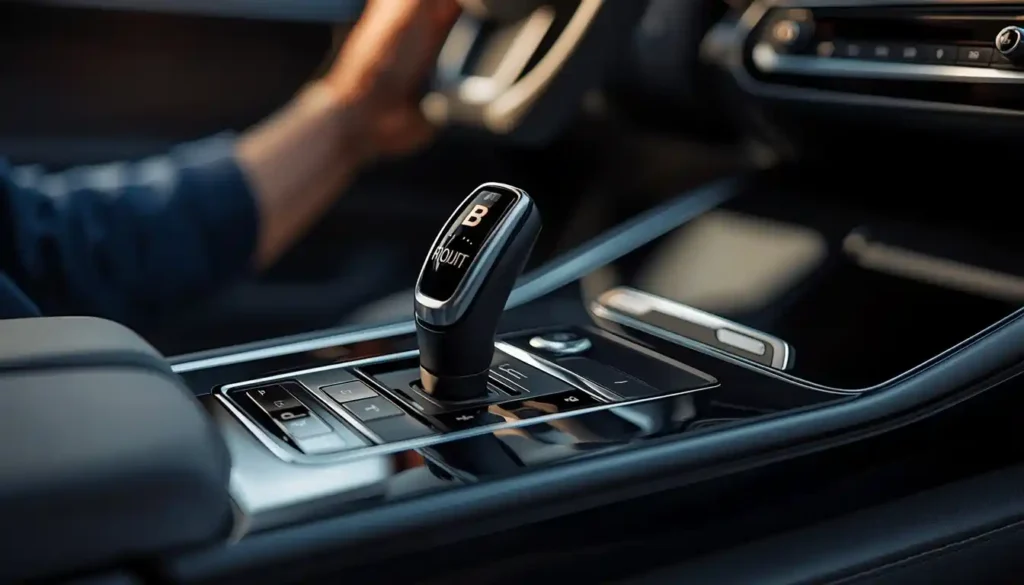
Regenerative braking has four settings: low, moderate, high, and adaptive. Adaptive uses navigation data and sensors ahead to decide how much regen to apply when you lift off. It took me a few days to trust it.
A fixed setting through the touchscreen gives more predictable behavior. B mode on the gear selector activates one-pedal driving, which slows the car to a near stop without touching the brake. It works well in stop-start traffic once you learn the feel.
BMW iX1 How It Drives Every Day
I drove the BMW iX1 from London to Edinburgh, and the motorway composure impressed me. Wind noise stays low, road noise is minimal, and the cabin has a hushed quality that makes long runs easy.
Power delivery is smooth, and the car sits planted at speed with no nervous behavior. It’s the driving environment where the price feels most justified.
Around town, the BMW iX1 suspension is the issue. BMW stiffened it to manage the battery weight, and the result is that potholes, speed bumps, and broken tarmac all make themselves known through the seat.
The car doesn’t crash over bumps; it tells you every detail about the road surface. After a long urban commute this wears on you. The Volvo EX40 is softer. The Mercedes EQA cushions more. If rough city streets are your daily reality, this matters.
On the B-roads I use regularly, it handles better than anything else in this class I’ve driven. Body roll stays controlled, steering is accurate, and the chassis feels balanced.
The M Sport with adaptive suspension is the trim that handles best and rides most comfortably on mixed surfaces. You’re always aware of the weight, but the car doesn’t fight you in corners.
BMW iX1 Real-World Range and Charging
Plan around these numbers instead of the WLTP figures. On the BMW iX1 eDrive20, expect 220 to 255 miles on UK mixed roads in mild weather.
At a constant 70 mph, budget 190 to 210 miles. In winter with heating running, plan around 170 to 190 miles. The xDrive30 runs 25 to 35 miles less across the same conditions.
The 130 kW DC charging ceiling is where this car falls behind rivals. Volvo’s EX40 charges at up to 200 kW. Tesla’s Model Y handles 250 kW. For daily home charging, none of this matters: you plug in overnight and start every morning full.
On a long road trip across Europe with multiple stops, the faster-charging competition saves 10 to 15 minutes per stop, which adds up over a full travel day.
The BMW iX1’s My BMW app handles route planning with charging stops built in. Plug and Charge support across Europe means compatible stations authenticate when you connect; no card is needed.
The BMW Charging Card included with every new iX1 covers thousands of public AC and DC points across Europe.
BMW iX1 Colours in 2026
Alpine White outsells every other iX1 colour in the UK and keeps its resale value better than most. Black Sapphire gives the car a sharper, more aggressive look that suits the Shadow Edition’s dark detailing.

The full range for 2026 includes Cape York Green, Fire Red, Night Dusk Blue, Dune Grey, Space Silver, Mineral White, Frozen Pure Grey, and Frozen Portimao Blue. The frozen matte finishes carry a premium. M Sport gets the widest color selection.
How It Stacks Up Against the Competition
| Car | UK Price From | WLTP Range | DC Charge Speed | Boot Space |
| BMW iX1 eDrive20 | £43,305 | 321 miles | 130 kW | 490 L |
| Audi Q4 e-tron 40 | £45,347 | 316 miles | 135 kW | 520 L |
| Volvo EX40 | £42,360 | 329 miles | 200 kW | 452 L |
| Mercedes EQA 250+ | £49,760 | 298 miles | 100 kW | 340 L |
| Tesla Model Y RWD | £44,990 | 373 miles | 250 kW | 854 L |
| Skoda Elroq 85 | £38,950 | 370 miles | 175 kW | 470 L |
| BMW iX2 xDrive30 | £52,245 | 267 miles | 130 kW | 413 L |
The BMW iX1 wins on interior quality, driving feel, and build finish. The Tesla Model Y beats it on range, charging speed, and boot space at a similar price. The Volvo EX40 matches the iX1 on range and charges 70 kW faster.
The Skoda Enyaq 85 beats it on both range and charging for £4,000 less. Where the BMW badge delivers is in the driving character and cabin quality that none of these rivals fully match. How much that matters depends entirely on what you drive every day and whether you charge at home.
iX1 vs iX2: Which One Makes More Sense?
The BMW iX2 shares the same platform and drivetrain but gets a sloped coupe roofline that costs rear headroom and cuts the boot to 413 liters. Both the iX2 xDrive30 M Sport and the iX1 xDrive30 M Sport sit at £52,245.
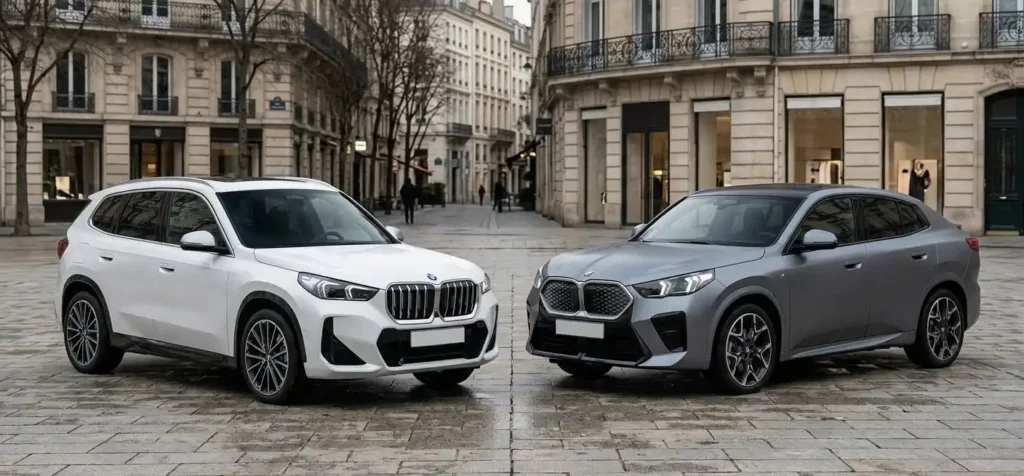
For the same money, the iX1 gives more practical space. The iX2 gives a sportier profile. Most families with children or dogs pick the iX1 within five minutes of sitting in both.
Safety and Warranty
Euro NCAP awarded five stars to the BMW iX1 platform. Adult occupant protection scored 86 percent. The child occupant scored 89 percent. Safety assistance systems reached 92 percent.
Pedestrian safety scored 75 percent, the weakest category. Every trim includes front and rear parking sensors, a reversing camera, lane departure warning, and automatic emergency braking with pedestrian detection as standard.
BMW ranked eighth out of 31 brands in owner satisfaction data, above Volvo. The vehicle warranty is three years with no mileage cap. The battery warranty covers eight years or 100,000 miles, with BMW guaranteeing at least 66.5 percent of original capacity at that point.
Is It Worth Buying in 2026?
After 800 miles in the BMW iX1 across motorways, cities, and country roads, my verdict is this: The eDrive20 M Sport is the sweet spot.
It covers enough range for most buyers, costs £8,000 less than the xDrive30 M Sport, and the interior and driving characteristics are identical. The performance gap between 8.6 and 5.6 seconds to 62 mph matters far less on actual roads than it looks on paper.
The firm suspension is a genuine daily friction point on broken city roads. The 130 kW charging ceiling works fine for home-charged daily use but costs time on long trips where competitors top up faster.
If your budget reaches £52,000 or above, I’d check the BMW iX3 first. It’s larger, has better range, and feels more complete as a package.
For buyers spending £43,000 to £49,000 on a compact premium electric SUV, the BMW iX1 eDrive20 M Sport, the eDrive20 M Sport is one of the best answers available right now. The BMW iX1 won’t top every spec table. But every time I got out of it, I wanted to get back in.
Frequently Asked Questions
Q: What is the BMW iX1 price in the UK for 2026?
A: The BMW iX1 starts from £43,305 for the eDrive20 Sport. Prices reach £58,985 for the xDrive30 Shadow Edition. Monthly lease payments start from around £379. On the used market, examples are available from approximately £22,920.
Q: How far does the BMW iX1 go on a charge?
A: The eDrive20 delivers up to 321 miles WLTP in 2026. Expect 220 to 255 miles in mild weather on British roads. The xDrive30 achieves up to 267 miles WLTP and around 200 to 230 miles in normal driving.
Q: What are the BMW iX1 charging times?
A: Using a 130 kW DC fast charger, the battery goes from 10 to 80 percent in 29 minutes. A full charge from flat on an 11 kW home wallbox takes around 6 hours 30 minutes.
Q: Is the BMW iX1 available in the US?
A: BMW hasn’t brought the iX1 to North America at all. If you’re shopping in the US, the BMW iX is the closest thing, starting from $75,150, though it’s a much larger and more expensive car.
Q: What is the difference between BMW iX1 eDrive20 and xDrive30?
A: The eDrive20 has one front motor, 201 hp, front-wheel drive, and up to 321 miles of WLTP range. The ix1 xDrive30 has two motors, 313 hp, all-wheel drive, a 0-62 mph time of 5.6 seconds, and up to 267 miles WLTP range. The xDrive30 costs £8,000 to £10,000 more depending on trim.
Q: What is BMW Operating System 9?
A: BMW Operating System 9 runs the Curved Display in the iX1. It handles navigation, media, and vehicle settings and connects to the My BMW app. The home screen is customizable with widgets, and everything works by touch or voice command.
Q: Can you drive the BMW iX1 with one pedal?
A: It does. Flick the gear selector into B mode, and the iX1 bleeds speed aggressively when you lift off, right down to a near stop without touching the brake pedal. I use it in city traffic constantly.
Q: What colours does the BMW iX1 come in for 2026?
A: BMW gives you eleven colors to pick from in 2026. Alpine White and Black Sapphire are the two I see most on UK roads, and both hold resale value well. If you want something different, Cape York Green and Frozen Portimao Blue are the ones that actually turn heads.
Q: How does the BMW iX1 compare to the BMW iX2?
A: Both cars use the same underpinnings. The iX2 has a coupe roofline, a 413-liter boot, and less rear headroom. The iX1 has a 490-liter boot, more rear space, and the same price on comparable trims. The iX1 is the practical choice; the iX2 is the style choice.
Final Takeaway
I’ve driven a lot of electric SUVs in this price range, and the BMW iX1 is the one I’d actually recommend to a friend without adding a list of caveats. Not because it wins on every number; it doesn’t.
The Tesla Model Y has more range. The Volvo EX40 charges faster. The Skoda Elroq costs less. But none of them feel as good to drive every day, and none of them have a cabin that holds up as well after 12 months of real use.
The eDrive20 M Sport at £48,305 is where I’d put my money. The range covers most people’s weekly driving twice over. The interior is a step above anything in this class below £50,000.
And when you get on a good road and give it some throttle, it reminds you that BMW still knows how to build a car that rewards the driver.
If the 130 kW charging speed bothers you, or if boot space is non-negotiable, the Tesla Model Y at £44,990 is the honest answer. But if you want an electric SUV that feels like a BMW rather than a gadget on wheels, the iX1 is worth every penny of the asking price.
