
Affordable Electric SUVs
Tesla Model Y vs Volkswagen ID.4: 8-Foot Tighter Turn
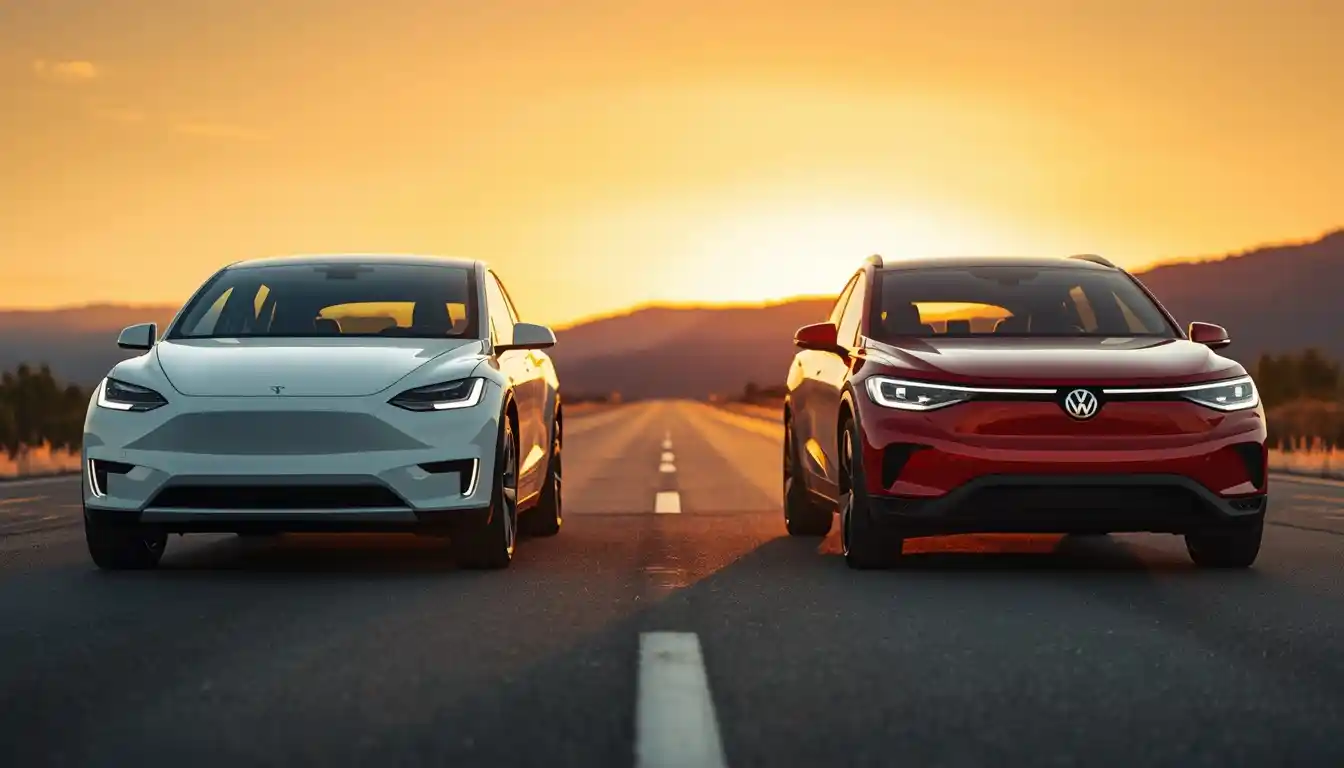
Weighing the Tesla Model Y vs the Volkswagen ID.4 and want a straight answer before you spend $40,000-plus? Here it is: the Model Y is the stronger electric vehicle on paper: better range, faster charging, sharper performance, and smarter software.
The ID.4 is the better car for most families and first-time EV buyers, with a softer ride, Apple CarPlay support, physical controls, and a driving feel that asks nothing new from you.
This guide covers every difference that matters, fills the gaps other reviews skip, and tells you exactly which one fits your life.
2026 Specs: Tesla Model Y vs Volkswagen ID.4 Side by Side
Here are the 2025/2026 base RWD numbers for both cars. Same trim level, same drivetrain, so you’re reading a fair comparison from the start.
| Spec | Tesla Model Y (RWD) | VW ID.4 Pro (RWD) |
| Starting Price | ~$41,630 | ~$45,095 |
| EPA Range | 321 miles | 291 miles |
| City MPGe | 134 | 122 |
| Highway MPGe | 117 | 104 |
| Horsepower | ~295 hp | 282 hp |
| 0-60 mph | ~6.8 sec | ~6.4 sec |
| Max DC Fast Charging | 250 kW | 170 kW |
| 10-80% Charge Time | ~15-27 min | ~30 min |
| Charging Port | NACS (Tesla) | CCS (Universal) |
| Apple CarPlay / Android Auto | Not available | Wireless, standard |
| Main Screen | 15.4 inch, all touch | 12.9 inch + physical sliders |
| Front Trunk (Frunk) | Yes | No |
| Cargo Space (seats up) | ~30.2 cu. ft. | ~30.3 cu. ft. |
| Turning Radius | 39.8 feet | 31.5 feet |
| Towing Capacity (AWD) | 3,500 lbs | 2,700 lbs |
| Basic Warranty | 4 yr / 50,000 mi | 4 yr / 50,000 mi |
The Tesla starts cheaper but ships without CarPlay. The ID.4 costs more upfront but bundles more everyday features into the base price.That price gap gets thinner fast once you build both cars to the same feature level, which we’ll break down properly in the value section.
Range and Real-World Efficiency: Does 30 Miles Matter?
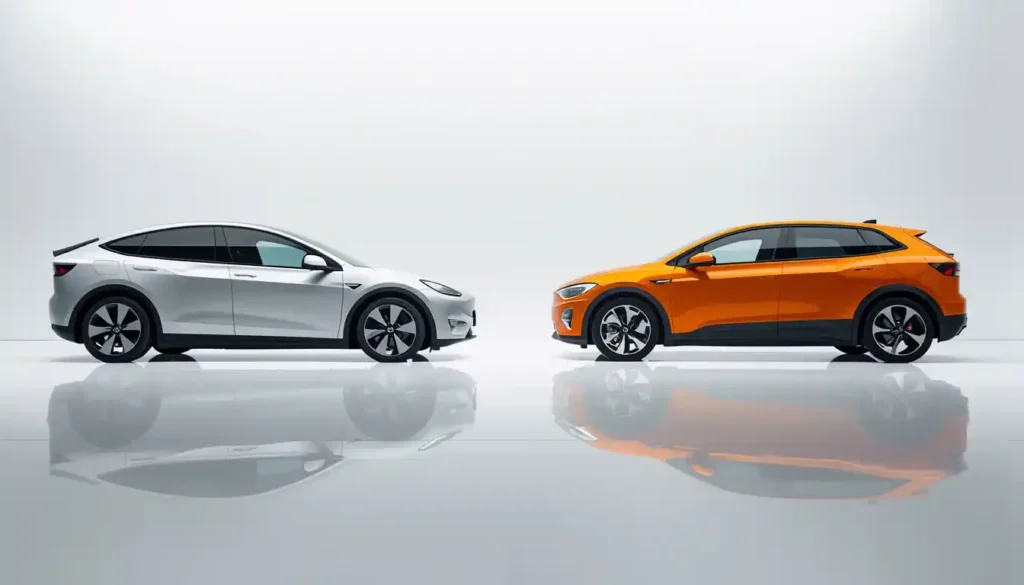
Range anxiety is the first thing on any new EV buyer’s mind, so let’s put real numbers on it. The Tesla Model Y RWD carries a 321-mile EPA rating, and in practice it holds close to that.
At 70 mph on the motorway with the climate running, most drivers see 280 to 300 usable miles before needing to plug in. That consistency is one reason Model Y owners stop thinking about range after the first few weeks of ownership.
The VW ID.4 Pro RWD is rated at 291 miles, but motorway speeds hit it harder. At 75 mph in moderate temperatures, you’re looking at roughly 220 to 250 miles of real-world driving.
Cold weather knocks it down further because the ID.4’s battery management, while solid, doesn’t squeeze miles out of a charge the way Tesla does. For daily drives under 80 miles with overnight home charging, neither car gives you anything to worry about. The gap only shows on longer journeys.
On raw efficiency, the Model Y leads by a clear margin: 134 MPGe city and 117 MPGe highway against the ID.4’s 122 and 104. That’s roughly 15% more electricity used per mile in the VW. Spread across 50,000 miles of driving, that difference lands on your electricity bill in a way you’ll notice.
Charging Experience: Tesla Network vs CCS Public Charging
Charging speed numbers only tell half the story. The other half is whether the charger is actually working when you pull up to it, and that’s where the two cars live very different lives on the road.
Tesla’s fast-charging network is still the most dependable public charging option available to any EV driver. You pull in, plug the cable in, and the session starts.
No app sign-in, no membership card tap, no staring at an error message in a motorway services car park. The Model Y accepts up to 250 kW and goes from 10% to 80% in roughly 15 to 27 minutes depending on the stall.
The ID.4 uses the CCS standard, which works across Electrify America, ChargePoint, EVgo, Blink, and most other public networks. That wide compatibility is a genuine plus since you’re not locked into a single provider.
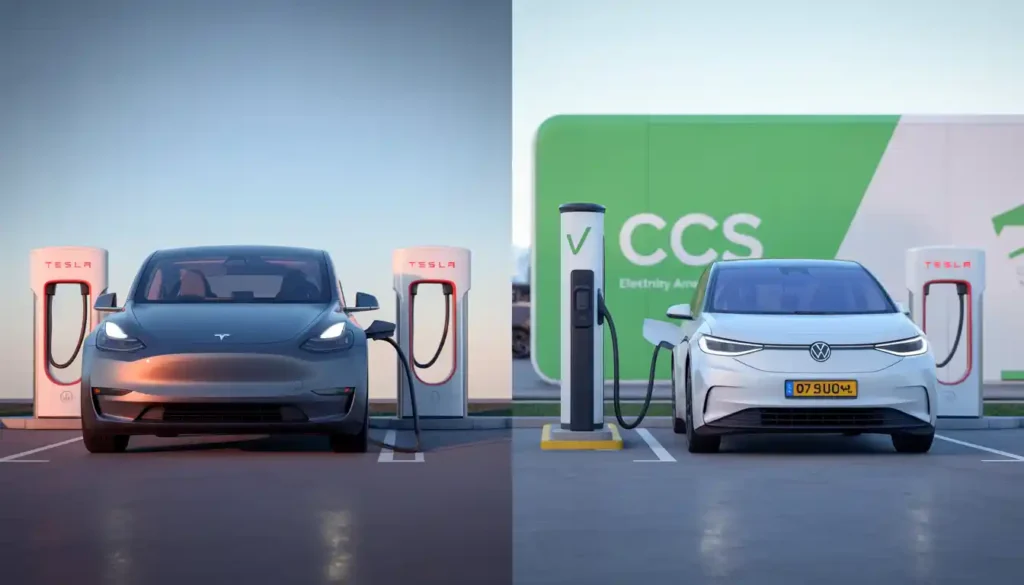
The 2026 ID.4 also includes 24 months of complimentary Electrify America Pass+ charging, which adds real value from day one. Peak charging hits around 170 kW on 2025/2026 models, up from 135 kW on earlier versions, and a 10-80% top-up takes about 30 minutes.
For drivers who charge at home most of the time, that setup works fine. For anyone doing three or four long drives a year, the reliability gap between public CCS networks and Tesla’s own stations is something you’ll feel in practice.
How Each Car Actually Drives
Put these two back to back on the same stretch of road and you’ll feel the difference before you’ve gone half a mile. They’re set up for completely opposite priorities.
The Model Y steers with proper weight and precision. The steering ratio is quicker, the car stays composed in bends, and the whole thing behaves more like a tall hatchback than a family crossover.
Regenerative braking is strong enough to handle city traffic on one pedal alone once you adjust to it. The suspension is firm, and there’s a sense of purpose to the way it moves that keeps driving interesting rather than just functional.
The ID.4 isn’t trying to do any of that. It’s built around absorbing road imperfections quietly and letting the driver relax.
The suspension is noticeably softer, the steering asks less of you, and the AWD Pro version covers 0-60 in about 4.9 seconds without ever making a fuss about it.
If your week involves school runs, supermarket trips, and motorway commutes, that unhurried character is something you’ll appreciate rather than criticise.
One ID.4 advantage that most comparison articles bury or skip entirely: its turning radius is 31.5 feet against the Model Y’s 39.8 feet.
That nearly 8-foot difference isn’t just a stat; it’s something you feel every single day in car parks, narrow side streets, and tight U-turns. ID.4 owners bring this up constantly. Model Y owners who’ve tried both bring it up too.
Tesla Model Y vs Volkswagen ID.4 Interior and Tech
Your answer to one question will probably decide this section: does Apple CarPlay or Android Auto matter to you every day? If yes, you already know which car wins here. If not, read on, because the differences go much deeper than phone connectivity.
Tesla Model Y: Everything Lives on the Screen
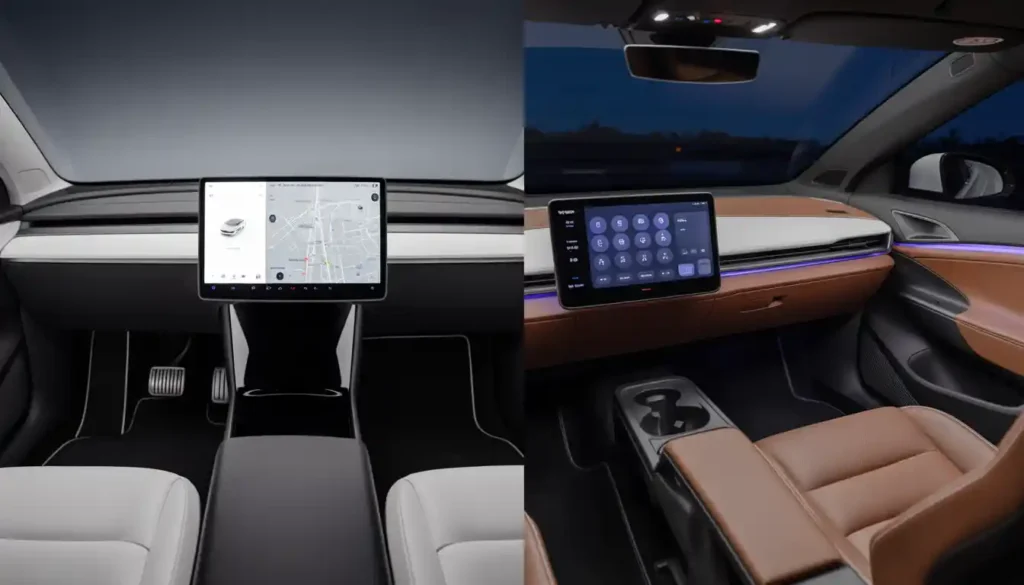
The Model Y’s cabin removes almost every physical control you’d normally reach for. The 15.4-inch touchscreen runs climate, mirrors, wiper speed, glovebox, and the charging port door.
There are two scroll buttons on the steering wheel, and that’s your lot. If you’re already living in a tech forward world and don’t rely on your phone’s maps or music apps inside a car, the clean interior feels like the right call.
If you’ve spent years reaching for a physical knob to turn up the heat, the adjustment period is longer than most people expect.
The Model Y has never had Apple CarPlay or Android Auto, not on base trims, not on top-spec versions, not at any point since the car launched.
Tesla’s own navigation works well, streaming is solid, and over-the-air software updates genuinely improve the car over time without any dealer visit.
But if Google Maps, Spotify through your phone, or Waze are part of your daily driving routine, none of that carries over. Some buyers only realize this after they’ve signed the paperwork.
The Model Y’s front trunk is worth pointing out. Charging cables, a gym bag, or a bag of groceries can go in the frunk without touching the main boot at all. ID.4 owners don’t get this, as the VW’s nose houses its HVAC components and 12V battery with no usable space left over.
VW ID.4: Your Phone Works the Same Way It Always Has
The ID.4 keeps a 12.9-inch screen for most controls but pairs it with physical sliders for temperature and fan speed. You can adjust the cabin heat without glancing away from the road. After spending time in the Model Y, that slider feels almost luxurious in its simplicity.
Wireless Apple CarPlay and Android Auto are standard across the full 2025/2026 ID.4 range. Connect your phone once and your maps, podcasts, messages, and music all behave exactly as they do on your phone and everywhere else.
For anyone who’s spent years building a routine around their phone’s apps, the ID. 4 slots right into that life without asking you to relearn anything.
Seat quality is a genuine ID.4 strength. More thigh support, a quieter cabin at speed, and interior materials that feel solid and considered. Heated front seats come standard on the Pro trim.
Early 2021 and 2022 models had haptic controls that owners found genuinely frustrating, and VW replaced those with proper physical alternatives on later builds, so 2023-onwards examples are a different experience to live with daily.
Safety and Driver Assistance
Both cars hold strong safety credentials. The Model Y earns a 5-star NHTSA rating across the board. The ID.4 scores well in both US and European crash testing. The standard kit on each includes automatic emergency braking, lane keep assist, adaptive cruise, and blind spot monitoring.
Tesla Autopilot handles motorway driving more smoothly. Lane centering holds its line more confidently, speed adjustments in heavy traffic feel more natural, and the experience as a whole is more refined for long drives.
It’s still a driver assistance tool, not an autonomous system, despite what the name suggests. The ID.4’s equivalent system is tuned more conservatively: it assists without taking over, which many drivers actually find less stressful for everyday use.
Price and What You Actually Get for Your Money
The Model Y’s base price sits about $3,500 below the ID.4 Pro’s. That sounds like a Tesla win until you look at the feature lists.
The ID.4 Pro includes wireless CarPlay and Android Auto, heated front seats, physical climate controls, and a full driver assistance package as standard.
Matching that spec on the Tesla requires moving up a trim or adding option packs. Price both cars to the same equipment level, and the gap shrinks to nearly nothing.
On the used market, the ID.4 often gives budget buyers a better deal. Tesla cut its prices multiple times in 2023 and 2024, and those cuts hit used Model Y values hard, and early buyers took a real paper loss.
The ID.4 follows a more predictable depreciation curve. A 2023 or 2024 used ID.4 that’s already absorbed its early value drop, with a manufacturer warranty still running, can be a strong buy.
One thing worth saying plainly: for some buyers in 2025 and 2026, the decision about Tesla involves more than specs. The brand’s public profile and its CEO’s associations have pushed a real number of shoppers toward alternatives.
That’s a personal call this article won’t push either way. What’s worth knowing is that the VW ID.4 holds its own as a competitor purely on what it does. It’s not a backup option; it’s a car that wins on its own terms for the right driver.
Who Should Buy the Tesla Model Y?
The Model Y suits drivers who spend time on long motorway runs and want a fast, reliable charging network waiting for them. It suits people for whom real-world range and efficiency genuinely matter and who want the best numbers in the compact electric SUV class.
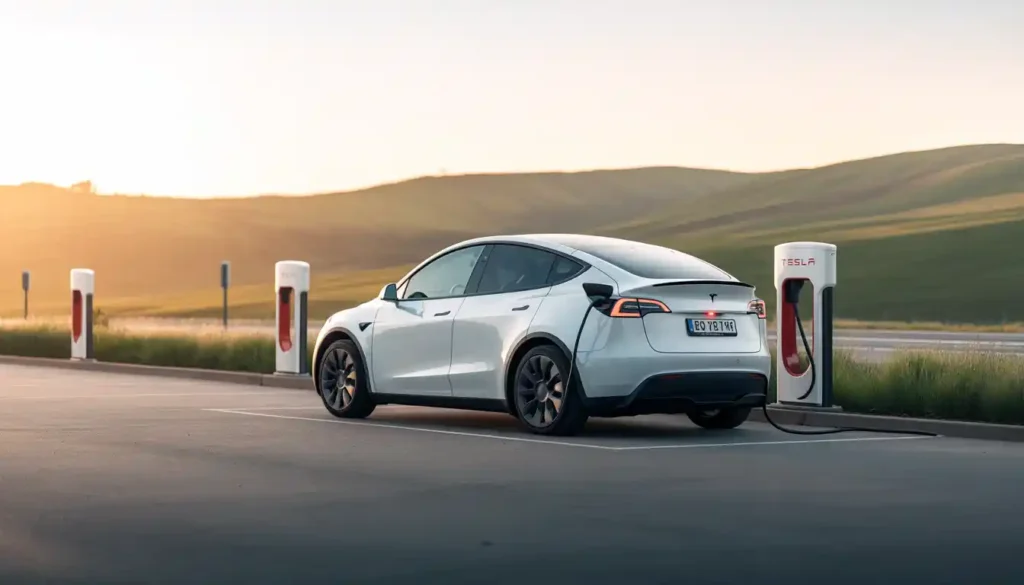
It works well for drivers who don’t use CarPlay or Android Auto and are happy living inside Tesla’s own software world. It’s also the stronger pick for occasional towing, with 3,500 lbs versus the ID.4’s 2,700 lbs with AWD.
Who Should Buy the VW ID.4?
The ID.4 suits drivers for whom Apple CarPlay or Android Auto is a daily habit they won’t trade away. It suits families who want a quiet, comfortable ride over sharp handling.
It’s the better pick for anyone buying their first electric vehicle who wants the change from petrol to feel as normal as possible.
It also suits buyers who value traditional dealership service, meaning local technicians, walk-in appointments, and a face they recognize when something needs attention.
Frequently Asked Questions
Q: Does the VW ID.4 have Apple CarPlay?
A: Yes. Wireless Apple CarPlay and Android Auto are standard on every 2025 and 2026 VW ID.4 trim. The Tesla Model Y has never included CarPlay or Android Auto in any version at any price.
Q: Which has better real-world range, the Model Y or the ID.4?
A: The Model Y comes out ahead. The base RWD version is rated 321 miles EPA and typically delivers 280-300 miles in everyday mixed driving. The ID.4 Pro RWD is rated at 291 miles but drops to around 220-250 miles at 75 mph motorway speeds, especially in colder months.
Q: Which charges faster, the Model Y or the VW ID.4?
A: The Model Y can charge more quickly. It accepts up to 250 kW and goes from 10-80% in roughly 15-27 minutes on a Tesla fast-charging stall. The ID.4 peaks at 170 kW and takes around 30 minutes for the same window.
Q: Is the VW ID.4 more comfortable than the Tesla Model Y?
A: Most drivers prefer the ID.4 due to its softer suspension, greater comfort for long-distance travel, and less noise inside the car at high speeds when compared to the Model Y, which has a more sporty suspension but can be tiring for some drivers when driving on poorly paved roads.
Q: Which is better for road trips?
A: The Tesla Model Y is better at going on long car trips. Its fast charging network is quicker and more reliable than public CCS options, and the car’s efficiency means you stop less often. The ID.4 can road trip too, but it needs more deliberate planning around charger locations.
Q: Can the VW ID.4 use Tesla Superchargers?
A: You can’t do it without a special connector. The ID.4 uses CCS ports, which don’t connect to Tesla stalls natively. Some Tesla sites are now open to non-Tesla vehicles, but the ID.4’s main public networks are Electrify America, ChargePoint, and EVgo.
Q: Is the ID.4 a good choice for a first electric vehicle?
A: Certainly one of the top destinations. Being CarPlay compatible means your daily phone habits won’t change.
Using physical controls helps with the transition process, and having that calm & smooth character while driving makes the transition from gasoline to electricity less scary!
Q: Does the VW ID.4 have a frunk like the Tesla Model Y?
A: No. The ID.4 has no front trunk. The Model Y includes a usable frunk that fits charging cables or small bags without touching the main trunk. Owners who switch from ID.4 to Model Y mention this more than almost anything else.
Q: Which holds its resale value better?
A: The Model Y had been historically more valuable until the consistent price decreases by Tesla through 2023 and 2024 changed the used Model Y prices.
The ID.4 has experienced depreciation at a much slower rate than the Model Y over the same time frame.
When you check today’s used market for either vehicle, you will find both vehicles to be very strong purchases, provided the trim, year, and mileage make sense for your situation.
The Bottom Line on Tesla Model Y vs Volkswagen ID.4
After going through every owner forum, every independent road test, and every gap in what competitors published, here’s what I found: the Tesla Model Y wins on the spec sheet.
Better range, faster charging, quicker to 60, more miles per unit of electricity, and software that keeps improving. The VW ID.4 wins in the driveway. It’s easier to hand over to any member of the family, it rides better on bad roads, and owning one doesn’t ask you to change how you use a car.
The best electric SUV is the one that fits how you actually live, not the one that wins the most categories on a table. If you’re still not sure after reading all of this, spend 20 minutes in each car. That drive will tell you more than any article can.
