
Affordable Electric SUVs
Cybertruck vs F-150 Lightning: Which Truck Actually Wins?

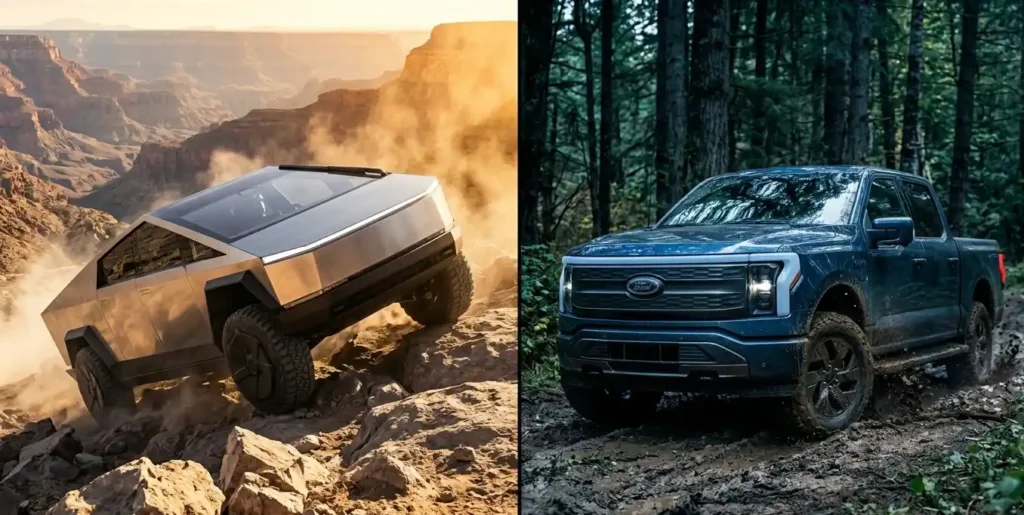
Shopping for an electric pickup truck in 2026? The Cybertruck vs. F-150 Lightning debate is still the biggest question in the segment. Short answer: The F-150 Lightning is the better work truck, and the Cybertruck is the better tech truck.

Which one you need depends entirely on how you actually use a truck. This article breaks down every major category with real test data, 2025 safety results most buyers haven’t seen yet, and the one cost difference that could save you $10,000 over five years.
Two Trucks, Two Completely Different Ideas
The Cybertruck vs. F-150 Lightning comparison starts with a fundamental design split. Ford built the F-150 Lightning by electrifying America’s best-selling vehicle.
It shares body panels with the gas F-150, fits in standard parking garages, and feels immediately familiar to any truck owner.
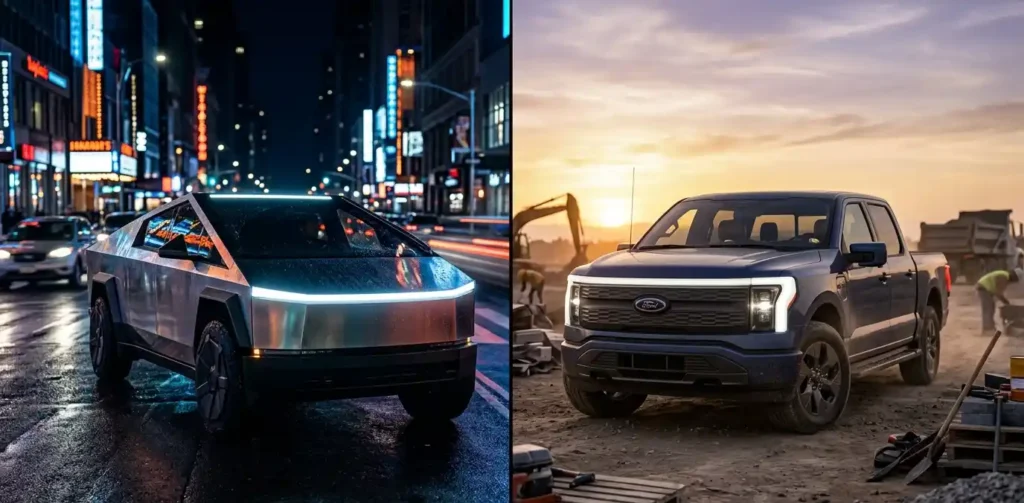
The Cybertruck took the opposite path. Tesla scrapped every truck convention and delivered an angular stainless steel machine that looks closer to a DeLorean DMC-12 than any pickup ever made.
That design difference isn’t just cosmetic. It signals who each truck is built for, and understanding that upfront will save you from an expensive mistake.
Price: The Gap Is Bigger Than You Think
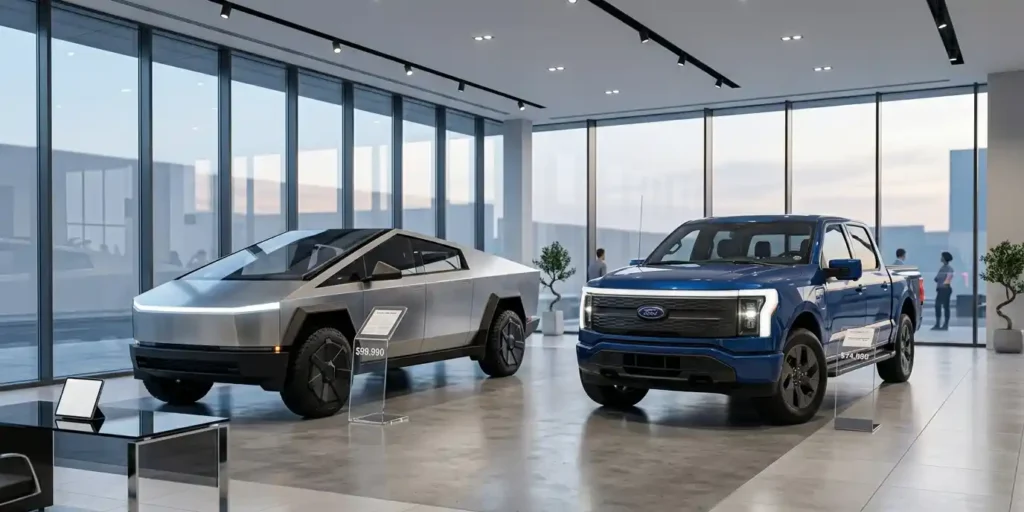
When you break down the Cybertruck vs. F-150 Lightning price, the F-150 Lightning XLT starts around $65,940. The Cybertruck AWD starts at roughly $81,985. That’s a $16,000 gap at the entry level.
At the top end, the Lightning Platinum sits around $91,995, while the Cyberbeast pushes past $99,990. The Lightning also gives you more trim options, so finding a price point that fits your budget is easier.
What almost no comparison article mentions: insurance. The Cybertruck averages $4,649 per year to insure. The F-150 Lightning averages $2,778.
Over five years, that’s roughly $9,355 extra just to insure the Cybertruck before you account for the higher purchase price. For a lot of buyers, that math ends the conversation before it starts.
Performance: Fast on Paper, Close in Reality
The Cybertruck wins on raw specs. The Cyberbeast hits 845 horsepower and 0-60 mph in 2.6 seconds. The dual-motor AWD does 0-60 in 4.1 seconds with 600 hp. The F-150 Lightning extended range produces 580 hp and reaches 60 mph in 3.8 seconds. Base Lightning trims do it in 4.1 seconds with 452 hp.
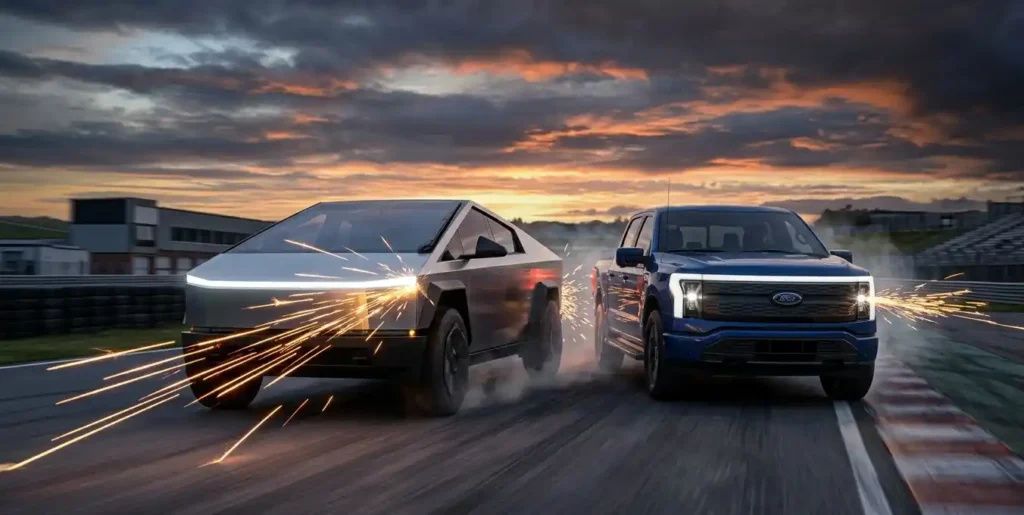
Those numbers look dramatic on paper. On a real road, the gap tightens. MotorTrend’s instrumented testing put the dual-motor Cybertruck at 12.4 seconds in the quarter mile versus the Lightning’s 12.8.
Both trucks also use steer-by-wire or conventional steering, but the Cybertruck’s rear-wheel steering genuinely does help in tight parking situations and on trails. That’s a real-world advantage the spec sheet can’t fully capture.
Towing and Payload: 1,000 Pounds vs Real Tools
For the Cybertruck vs. F-150 Lightning towing debate, the Cybertruck AWD and Cyberbeast both tow up to 11,000 lbs with 2,500 lbs of payload. The F-150 Lightning maxes out at 10,000 lbs of towing with the Max Trailer Tow Package and 2,235 lbs of payload on the extended-range pack.
That 1,000 lb towing advantage for the Cybertruck sounds significant until you look at what each truck actually gives you for job-site work. The Lightning comes with onboard scales to estimate payload weight and a Smart Hitch to estimate trailer tongue weight.
The Cybertruck has neither. Ford Pro Power Onboard delivers up to 9.6 kW of exportable power from the truck itself, enough to run power tools on a job site or keep your home running during a blackout.
The Cybertruck offers no comparable vehicle-to-home or vehicle-to-load feature. For contractors, tradespeople, and anyone who genuinely works a truck, those tools matter more than a 1,000 lb difference in towing ratings.
Real-World Range: EPA Numbers vs Highway Truth
The F-150 Lightning standard range battery delivers 240 miles, EPA-verified. The extended range hits 320 miles, also EPA-verified. The Cybertruck AWD claims 340 miles, and the Cyberbeast claims 320 miles. Tesla’s numbers are manufacturer estimates; not all trims carry full EPA certification.
Real-world results tell a different story. In MotorTrend’s standardized 70 mph road trip range test, the Cybertruck recorded 224 miles, and the Lightning extended range recorded 222 miles. Effectively identical at highway speed.
Edmunds’ range testing showed the Lightning Lariat hitting 345 miles and the Cybertruck Foundation Series hitting 334 miles at moderate speeds. Both trucks perform respectably, but the Lightning’s numbers carry EPA backing that Tesla’s do not fully match across all trims.
Charging: Faster at the Station, Slower at Home
The Cybertruck accepts up to 250 kW at DC fast chargers, compared to the Lightning’s 150 kW peak. At a Supercharger, the Cybertruck adds more range meaningfully in 15 minutes. That’s a real advantage for long road trips relying on public charging.

Flip that around for home charging, and the Lightning wins. It accepts up to 80 amps AC, filling from empty in about 8 hours. The Cybertruck tops out at 48 amps AC, needing roughly 11 hours for a full charge.
Since most EV owners charge at home overnight, the Lightning’s faster home charging is the more relevant daily advantage for the majority of buyers. Both trucks now access Tesla’s Supercharger network, so the infrastructure advantage Tesla once held has largely closed.
Interior and Daily Usability: Familiar vs Futuristic
The Lightning’s interior is a proper truck cabin. A 15.5-inch touchscreen sits alongside physical buttons for climate, radio, and common functions. Apple CarPlay and Android Auto work out of the box.
The front seat folds flat for job site naps. The Mega Power Frunk gives you 14.1 cubic feet of lockable, drainable storage at the front. Rear-seat legroom is genuinely spacious.
Tesla’s EV pickup goes all in on minimalism. Nearly every function routes through the 18.5-inch center screen. There’s no Apple CarPlay, no Android Auto.
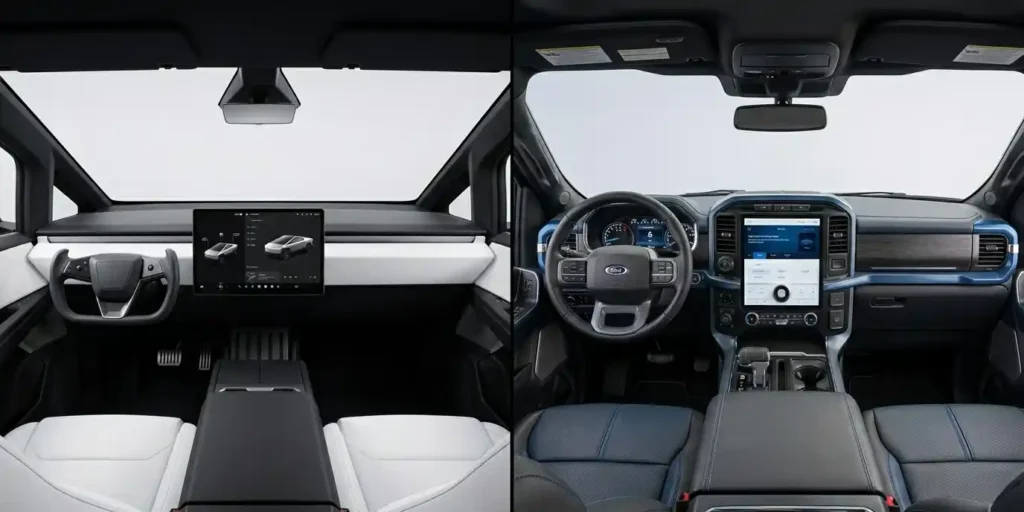
The rear seat is firmer and tighter. Edmunds’ team, including a staff member who daily drives a Tesla, found several functions genuinely hard to locate and remember.
The bed runs longer at roughly 6 feet versus the Lightning’s 5.5 feet, and the motorized integrated tonneau is excellent. But those high side rails make it harder to reach over than any conventional truck, which creates real friction for daily use.
2025 Safety Ratings: The Result That Surprised Everyone
This is the biggest story in the Cybertruck vs. F-150 Lightning safety debate that most buyers don’t know about yet. In late 2025, IIHS released crash test results for both trucks in the moderate overlap front test.
The Tesla Cybertruck earned a Good rating, which is IIHS’s highest score. The Ford F-150 Lightning received a Poor rating, which is IIHS’s lowest.
That’s a complete reversal of the expected outcome. The Lightning had earned five-star overall NHTSA safety ratings for the 2022, 2023, and 2024 model years. The 2025 IIHS moderate overlap result is a specific test the Lightning clearly failed.
Buyers who prioritize crash safety should treat this as a serious factor. The Cybertruck wins this category cleanly, and it’s one of the most objective wins in this entire comparison.
Off-Road: Marketing vs Real Trail Performance
Tesla marketed the Cybertruck aggressively as an off-road vehicle. Independent testing told a more complicated story. MotorTrend found the standard Goodyear Wrangler Territory RT tires had significantly shallower tread depth than comparably branded off road tires.
On a technical V-notch trail featuring a large boulder and extreme frame twists, the Cybertruck struggled more than both the Lightning and the Rivian R1T. Locking differentials that Tesla had promised at launch weren’t activated until later over-the-air updates, months after delivery.
The Lightning isn’t marketed as an off-road machine, but its rear locker kept it moving on obstacles where the Cybertruck’s stability control cut power.
The Cybertruck’s adjustable air suspension, with up to 16 inches of ground clearance, is a genuine advantage for moderate off-road use. For casual overlanding or rough dirt roads, it performs well.
For serious technical trials, the real-world results favor the Lightning’s more conventional but better-proven setup.
F-150 Lightning Discontinued: What It Means for 2026 Buyers
Ford officially ended F-150 Lightning production. A next-generation electrified F-150, likely built on a hybrid platform, is in development.
If you’re buying in 2026, this affects two things: dealer inventory levels may be limited or heavily discounted depending on your market, and long-term parts support is a legitimate question. The Cybertruck remains in active production.
For buyers who plan to own for 10 or more years, the Lightning’s discontinuation is worth factoring into the decision. For buyers who trade every 3 to 5 years, remaining inventory pricing may actually work in your favor.
Cybertruck vs F150 Lightning: Full Specs at a Glance
| Spec | Tesla Cybertruck AWD | F-150 Lightning ER |
| Starting Price | ~$81,985 | ~$65,940 |
| Horsepower | 600 hp (AWD) / 845 hp (Beast) | 580 hp |
| 0-60 mph | 4.1 sec / 2.6 sec (Beast) | 3.8 sec |
| EPA Range | 340 miles (mfr est.) | 320 miles (EPA verified) |
| Max Towing | 11,000 lbs | 10,000 lbs |
| Max Payload | 2,500 lbs | 2,235 lbs |
| DC Fast Charge | 250 kW | 150 kW |
| AC Home Charging | 48A (~11 hrs) | 80A (~8 hrs) |
| Bed Length | ~6 ft | 5.5 ft |
| Apple CarPlay | No | Yes |
| Vehicle-to-Home | No | Yes (9.6 kW) |
| IIHS Moderate Overlap | Good (2025) | Poor (2025) |
| Avg. Annual Insurance | ~$4,649 | ~$2,778 |
| Production Status | Active | Discontinued |
Which One Should You Actually Buy?
After going through every category, the Cybertruck vs. F-150 Lightning verdict isn’t one-size-fits-all. Buy the F-150 Lightning if you use your truck for work, towing regularly, running tools off the bed, or powering your home.
It costs less to buy, less to insure, charges faster overnight, and comes with practical features the Cybertruck simply doesn’t have. Its familiar design means zero learning curve, and the conventional bed is genuinely easier to use every day.
Buy the Cybertruck if advanced technology matters more to you than cost, if you charge primarily at public DC stations, and if you want the best crash safety rating of any electric truck on the market right now.
The 2.6-second 0-60 of the Cyberbeast is a real thing. The steer-by-wire system is genuinely impressive engineering. And unlike the Lightning, it’s still in production with a clear future.
Neither truck is universally better. The Cybertruck vs. F-150 Lightning decision comes down to one question: what do you actually do with a truck every day?
Frequently Asked Questions
Q: Is the Cybertruck better than the F-150 Lightning for towing?
A: The Cybertruck claims 11,000 lbs max towing versus the Lightning’s 10,000 lbs. In real-world tow tests, both trucks lose roughly one-third of their range hauling moderate trailers at highway speeds. The Lightning adds Smart Hitch and Onboard Scales for practical towing use that the Cybertruck lacks.
Q: Which has better range: Cybertruck or F-150 Lightning?
A: The Cybertruck AWD claims 340 miles versus the Lightning’s EPA-verified 320 miles on the extended range pack. At 70 mph in real testing, both trucks record nearly identical results around 222 to 224 miles. With the optional range extender, the Cybertruck can exceed 470 miles.
Q: Which electric truck charges faster in 2026?
A: The Cybertruck is faster at DC public stations, accepting 250 kW vs the Lightning’s 150 kW. The Lightning is faster at home, accepting 80A AC vs the Cybertruck’s 48A. Most owners charge at home, making the Lightning’s home charging speed the more practical daily advantage.
Q: Is the F-150 Lightning discontinued?
A: Yes. Ford ended all-electric F-150 Lightning production. A next-generation hybrid-based F-150 is in development. In 2026, check dealer inventory for available stock, which may be priced at a discount.
Q: Which is safer: Cybertruck or F-150 Lightning?
A: In 2025 IIHS moderate overlap crash testing, the Cybertruck earned a Good rating while the F-150 Lightning received a Poor rating. The Lightning previously held five-star NHTSA overall ratings for 2022 through 2024 model years. Both datasets are relevant for a complete safety picture.
Q: Which electric truck has lower insurance costs?
A: The F-150 Lightning averages around $2,778 per year to insure, compared to roughly $4,649 annually for the Cybertruck. Over five years, that difference adds up to approximately $9,355, a significant ownership cost most buyers overlook entirely.
