
Plug-in Hybrid
BMW i8 Value: Check Real 2026 Resale Numbers
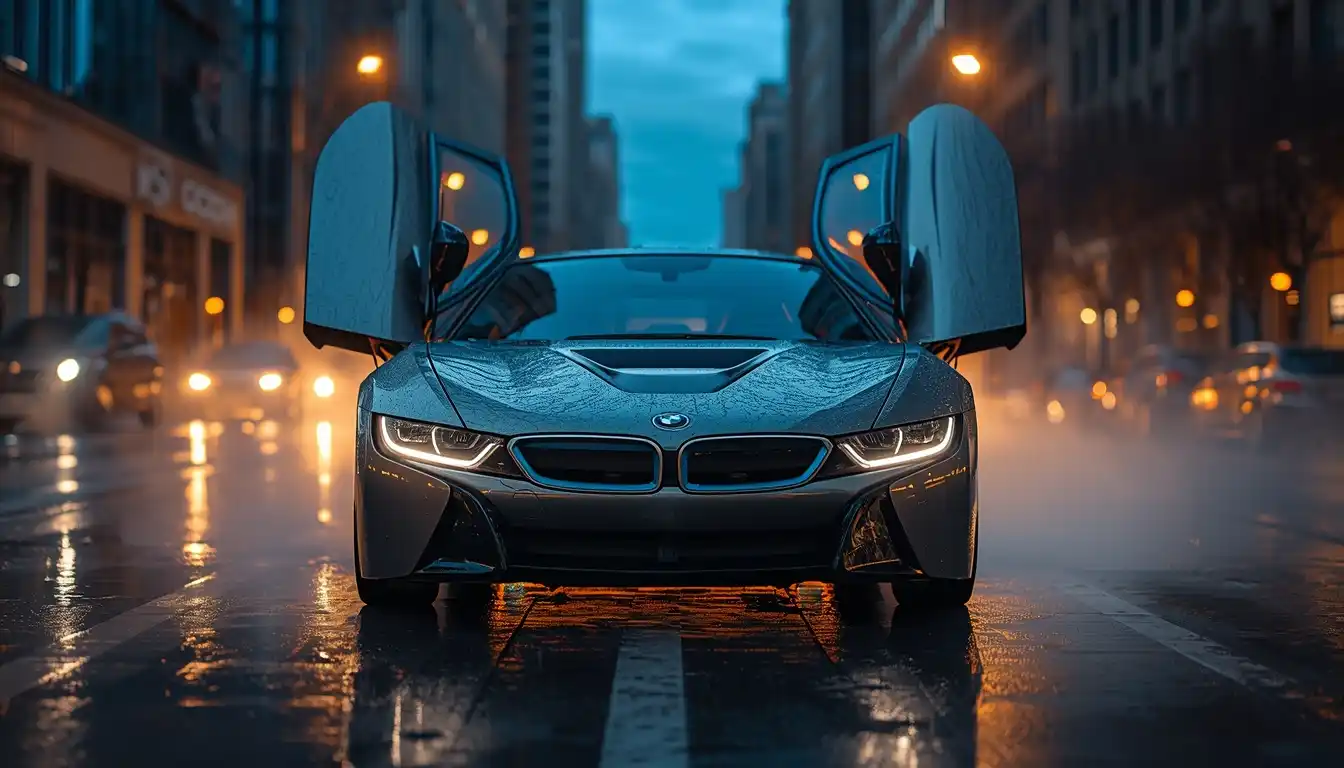
If you’re looking for the BMW i8 price, here’s the direct answer: on the used market today, a BMW i8 sells for somewhere between $40,000 and $75,000 in the United States, depending on model year, mileage, and whether you’re shopping for the coupe or the limited roadster.
When BMW launched the i8 in 2014, the starting price was $135,925. By 2020, the final production year, the BMW i8 cost $148,495 for the coupe and $164,295 for the roadster.
BMW discontinued it after that, but the i8 remains one of the most visually dramatic plug in hybrid sports cars ever built.
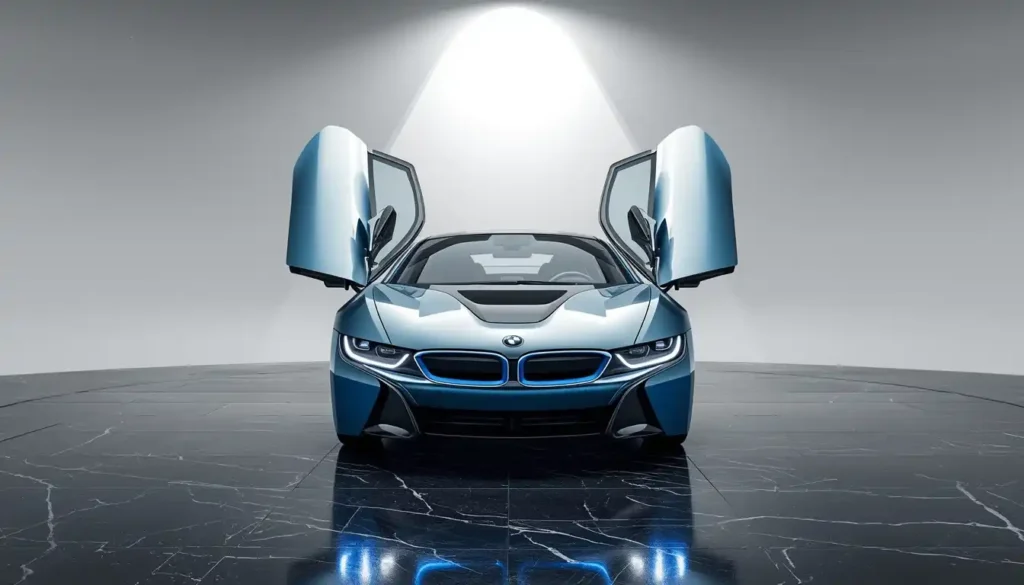
I’ve pulled together everything you need to know, from real pricing data and performance specs to fuel economy, ownership costs, and whether buying one today actually makes sense.
What Is the BMW i8?
The BMW i8 is a plug in hybrid sports car produced by BMW from 2014 to 2020 under its BMW i electric sub brand. It’s the kind of car that stops traffic before you even start the engine.
You get a low slung carbon fiber body, butterfly doors that swing upward, laser headlights, and a dual powertrain system that nothing else in its price range could match at the time.
BMW built the i8 on a carbon fiber reinforced plastic passenger cell called the “life module,” mounted on an aluminum “drive module.” The result is a car that weighs just 3,455 pounds while carrying two complete powertrains and a full battery pack.
That’s genuinely impressive engineering. BMW produced only 20,465 units worldwide before calling it a day, making this BMW sports car, the i8, legitimately rare on American roads.
Of those, 16,581 were coupes, and just 3,884 were roadsters. The Roadster arrived in 2019 as a soft top two seater with a power folding roof that stows in less than 16 seconds.
Buyers in the United States searching for a BMW i8 in 2026 are shopping in an entirely used market. BMW closed the production line in June 2020, which means every i8 on a US dealer lot today is a pre-owned car. Prices range from $40,000 for high-mileage early coupes to over $90,000 for low-mileage roadsters with clean history.
“BMW’s other performance hybrid, the BMW XM, takes a completely different approach with an SUV body.”
BMW i8 Price in USA 2026: New vs Used Market
Understanding the full price story of the BMW i8, from new MSRP down to today’s used market, gives you a much clearer picture of what you’re actually buying. Most sources give you one number or the other. Here’s both, plus context.
| Price Reference | Amount |
| 2014 Launch Price (U.S.) | $135,925 |
| 2020 Coupe MSRP (Final Year) | $148,495 |
| 2020 Roadster MSRP (Final Year) | $164,295 |
| Current Used Average (U.S.) | ~$68,502 (per MotorTrend / Classic.com data) |
| Typical Used Range | $40,000 to $75,000 |
| Low-Mileage Coupe (under 20K mi) | $65,000 to $80,000 |
| High-Mileage Coupe (80K+ mi) | $35,000 to $48,000 |
| Low-Mileage Roadster | $80,000 to $100,000+ |
If you’re searching for a 2022 BMW i8, here’s what you need to know upfront. BMW closed the production line in June 2020, so there’s no such thing as a brand new 2022 model. What you’re actually looking at is a pre-owned coupe that was sold, registered, or transferred after the factory stopped building them.
These cars still show up on dealer lots and private listings today. Pricing on a 2022 BMW i8 generally falls somewhere between $48,000 and $68,000 in the US, though mileage and service history move that number quite a bit in either direction.
A clean low-mileage example with full BMW service records commands a real premium over a high-mileage car with patchy paperwork.
Why Did the BMW i8 Depreciate So Fast?
The BMW i8 dropped in value quickly because it sat in an awkward spot. It wasn’t fast enough to compete with the Porsche 911 Turbo crowd, and it wasn’t efficient enough to challenge proper electric vehicles on range.
Charging $150,000 for a car powered by a 1.5-liter three cylinder engine was always going to create an expectations problem. The market repriced it fast. Today, that depreciation actually works in your favor if you understand what the i8 really is.
BMW i8 Coupe vs. Roadster: What’s the Price Difference?
The BMW i8 coupe is the common variant, which keeps its used price more accessible. The BMW i8 convertible, sold as the Roadster, regularly commands $15,000 to $25,000 more than a comparable coupe because BMW only built 3,884 of them.
If open air driving and exclusivity are your priorities, budget for the premium. If value matters more than rarity, the Coupe is the smarter buy at current prices.
BMW i8 Price by Year: 2014 to 2024
| Year | Type | Original MSRP | Avg Used Price 2026 |
|---|---|---|---|
| 2014 | Coupe | $135,925 | $38,000 to $48,000 |
| 2015 | Coupe | $140,700 | $40,000 to $52,000 |
| 2016 | Coupe | $140,700 | $42,000 to $54,000 |
| 2017 | Coupe | $140,700 | $44,000 to $56,000 |
| 2018 | Coupe | $147,500 | $50,000 to $62,000 |
| 2019 | Coupe | $147,500 | $54,000 to $68,000 |
| 2019 | Roadster | $163,300 | $72,000 to $90,000 |
| 2020 | Coupe | $148,495 | $58,000 to $75,000 |
| 2020 | Roadster | $164,295 | $80,000 to $100,000+ |
| 2022 | Pre-owned only | N/A | $48,000 to $68,000 |
| 2023 | Pre-owned only | N/A | $50,000 to $70,000 |
| 2024 | Pre-owned only | N/A | $52,000 to $72,000 |
The price of an i8 BMW shifted noticeably across its six-year production run. The 2014 BMW i8 launched at $135,925, which was remarkable for a carbon -fibre sports car at that price point. By the 2015 BMW i8, MSRP had moved to $140,700 as demand picked up.
The 2018 BMW i8 brought a meaningful upgrade, pushing combined output to 369 hp alongside a larger battery. That same year, BMW introduced the BMW i8 Roadster at $163,300, a soft-top two-seater built in far smaller numbers than the coupe.
The i8 Roadster stayed in production until 2020, and today a clean, low-mileage example commands a serious premium over comparable coupes.
The 2014 BMW i8 and 2015 BMW i8 were the earliest production models, and both established the car’s reputation before the BMW i8 roadster arrived in 2019 as the open top alternative to the coupe.
BMW i8 Specs and Performance Numbers
The BMW i8 powertrain is clever engineering, even if the output sounds modest on paper. The BMW i8 engine is a 1.5-liter BMW TwinPower Turbo three-cylinder gasoline unit driving the rear wheels through a six-speed automatic.
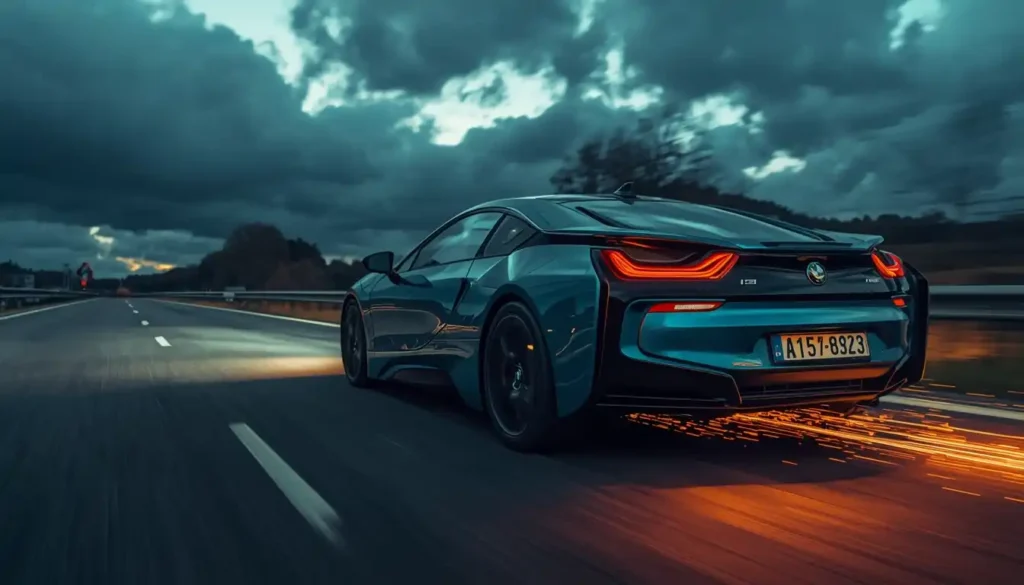
Paired with it is an electric motor at the front axle, giving the car true all-wheel drive through a two speed automatic. They operate together or independently, depending on your selected drive mode.
| Specification | Detail |
| BMW i8 Horsepower (2018-20, Combined) | 369 hp |
| BMW i8 Horsepower (2014-17, Combined) | 357 hp |
| Combined Torque | 420 lb-ft |
| BMW i8 0-60 (Coupe) | 4.2 seconds |
| BMW i8 0-60 (Roadster) | 4.4 seconds |
| BMW i8 Top Speed | 155 mph (electronically limited) |
| Battery Pack (2018-20) | 11.6 kWh |
| Battery Pack (2014-17) | 7.1 kWh |
| Electric-Only Range (EPA) | 18 miles (2019-20 models) |
| Total Range (gas + battery, EPA) | ~330 miles |
| Drivetrain | AWD (gas rear / electric front) |
| Curb Weight | 3,455 lbs (Coupe) |
| BMW i8 Fuel Capacity | 11.1 gallons |
| BMW i8 Production Years | 2014 to 2020 |
| Body Construction | Carbon fiber-reinforced plastic (CFRP) |
Is the BMW i8 Actually Fast?
That depends on your frame of reference. The BMW i8’s HP total of 369 combined horsepower puts the 0-60 time in the same ballpark as a Porsche 911 Carrera T. MotorTrend recorded 3.8 seconds in their own testing with launch control engaged.
What makes the BMW electric sports car i8 feel quick in real world driving is the instant torque delivery from the electric motor at low speeds.
You get the full electric thrust from a dead stop, which is exactly why the BMW i8 0-60 time feels quicker than it reads on paper. Where it starts to show its limits is above 80 mph, when that three-cylinder engine runs out of breath on a long highway pull.
How the BMW i8 Hybrid System Works
The BMW i8 hybrid system offers three driving modes. In eDrive mode, the car operates entirely on electric power up to 75 mph, running quietly like a city commuter. Comfort mode blends both power sources based on demand.
Sport mode activates everything simultaneously and engages the regenerative braking system more aggressively, recapturing kinetic energy during deceleration to keep the battery charged.
This is the same regenerative braking principle used in the BMW 330e M Sport and the VW Golf GTE, but the i8 applies it inside a proper sports car body that those cars can’t touch for drama or design.
BMW i8 Fuel Economy: Official Numbers vs. Real World
The BMW i8 fuel economy figures look outstanding on paper, and they hold up reasonably well in real world driving, but only if you’re plugging in regularly. Here’s the full picture.
| Fuel Economy Metric | Figure |
| MPGe (EV mode, EPA 2019-20) | 69 MPGe |
| Gas-Only MPG (battery depleted) | 27 to 29 mpg combined |
| Real-World City MPG | ~23 mpg (heavy traffic) |
| Real-World Highway MPG | ~30 to 35 mpg |
| BMW i8 Fuel Capacity | 11.1 gallons |
| Approximate Gas Range (full tank) | ~300 to 330 miles |
| EV-Only Range (real world with A/C) | ~15 to 19 miles |
| BMW i8 Fuel Consumption (NEDC) | 2.1 L/100km (~112 mpg equivalent) |
| CO2 Emissions (NEDC, charged battery) | 49 g/km |
In practice, BMW i8 fuel efficiency depends almost entirely on your daily habits. If you charge the battery every night and drive mostly city routes under 20 miles, your gas mileage in the BMW i8 looks extraordinary.
One owner with 30,000 miles on their car reported 30 mpg on long highway drives and 23 mpg in stop-and-go traffic after the battery depleted. That’s roughly what you’d expect from a BMW 330e M Sport running on gasoline.
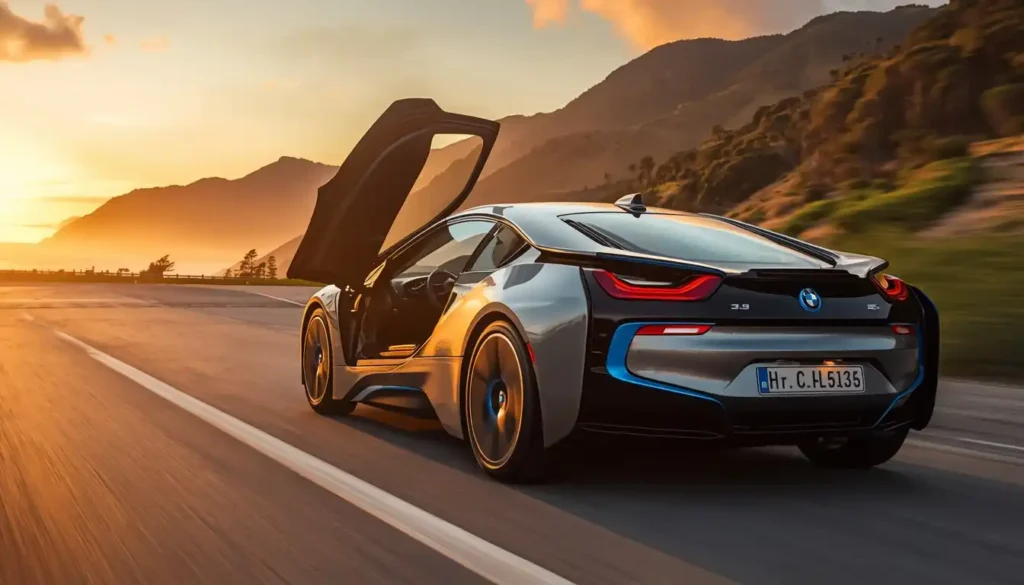
The BMW i8 fuel consumption climbs noticeably in Sport mode because the system actively uses the gas engine to recharge the battery.
The mpg for the BMW i8 beats every comparable sports car in its price class, including the Porsche 911 Carrera, which returns 19 to 24 mpg depending on the variant.
The mpg of the BMW i8 in combined driving consistently outperforms rivals at this price point. The i8 BMW’s MPG advantage is real and meaningful for daily drivers.
BMW i8 Interior, Design, and Daily Usability
Walk up to a BMW i8 and you immediately understand why it appeared in Mission: Impossible before it was even on sale.
The exterior design, with its wide stance, sculpted bodywork, and the BMW with butterfly doors that swing upward rather than out, still looks completely current in 2026. Very few cars from 2014 can say that.
The BMW i8 black finish is particularly striking, and the contrast between the dark bodywork and blue accent lighting became one of its signature looks in the U.S. market.
Step inside, and the story gets more nuanced. The BMW i8 interior uses carbon fiber trim pieces, an optional E-Copper leather upholstery package, and a digital instrument cluster that felt genuinely futuristic at launch.
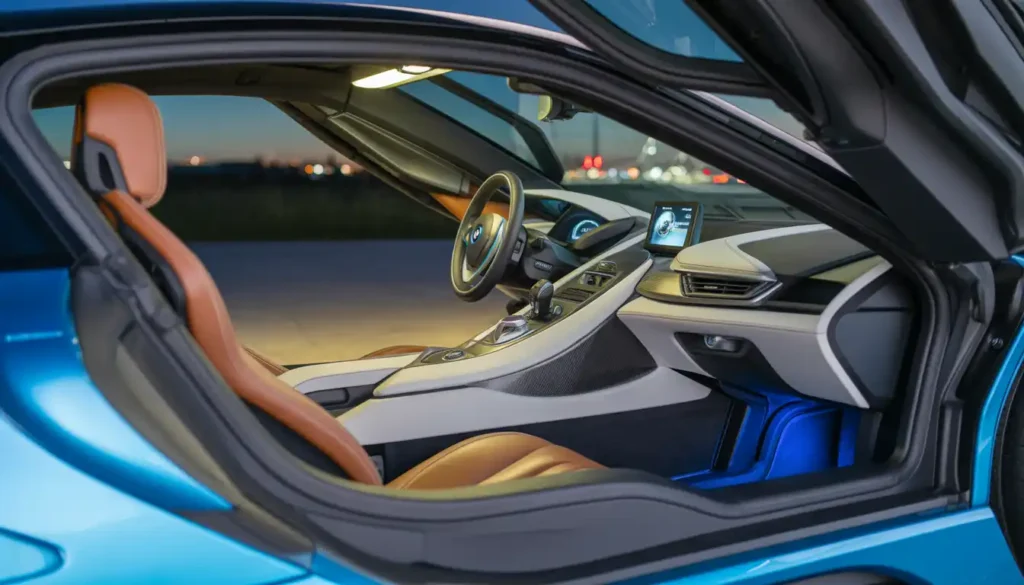
The heads-up display projects speed and navigation data cleanly onto the windshield. What lets it down is the quality of the switchgear and minor controls, which came from lower-tier BMW models.
For a car with a starting BMW i8 price above $135,000, you’d reasonably expect better materials throughout the cabin. Car and Driver called it out specifically in their long-term review, and that’s a fair criticism.
Practicality? The BMW i8 coupe has 5.4 cubic feet of trunk space. There’s no frunk because the front electric motor fills that area. The rear seats fit children comfortably and adults for short trips only.
Getting in and out requires technique: the wide sill and low roofline mean you slide your hips in first rather than stepping in normally. The BMW i8 convertible Roadster trades those rear seats for the folding roof mechanism, giving you two seats and a full open air experience.
If you’re buying this as a weekend car or a second vehicle, none of this matters much. If you need it as your only car, plan accordingly.
BMW i8 Review: What Real Owners Actually Experience
The BMW i8 review conversation in the U.S. splits into two camps almost immediately. Critics focus on the 1.5-liter three cylinder engine and question why BMW didn’t use something more powerful.
Owners who actually drive one regularly point to the sub-$2,000 annual maintenance cost, the head turning effect at every stoplight, and running expenses closer to a Prius than a supercar. Both groups are correct, and both are missing the bigger picture.
Here’s what the long term ownership data shows. The BMW i8 running costs are genuinely low for a sports car of this visual impact. No clutch packs to replace, no V8 fuel bills, no annual service visits that cost four figures.
One long-term owner described total annual running costs similar to a Toyota Camry, with the looks of a Lamborghini from the outside.
The regenerative braking system reduces brake wear so significantly that brake pad replacement comes up far less frequently than on a conventional sports car. Oil change once a year. Brake fluid every two years. That’s the typical annual service schedule.
What makes the BMW i8 genuinely misunderstood in American car culture is the performance expectation mismatch. People assume it should compete with the Lamborghini Huracan because it looks like it should.
Wrong comparison. Compared to the Acura NSX, which uses the same plug in hybrid concept at nearly three times the price, the BMW i8 starts looking like one of the best value propositions in automotive history.
For a full breakdown of yearly costs, insurance, and battery health over time, see our BMW i8 long term ownership guide.
BMW sold more i8 units globally in 2015 than all competing hybrid sports cars combined.
Common Problems to Know Before You Buy
The BMW i8 is now a 5- to 11-year old car, and BMW ended parts production in 2020. Air conditioning system repairs have ranged from $2,000 to $4,000 on some units.
Front suspension wear, particularly control arms, shows up around 50,000 to 80,000 miles and runs $1,500 to $3,000 to address. Budget $2,000 to $5,000 per year in maintenance if you drive it regularly year round.
The hybrid battery warranty covers eight years or 100,000 miles on covered components, so check exactly where any specific car sits against that window.
Early 2014-2017 units with the smaller 7.1 kWh battery often deliver only 12 to 14 miles of real-world electric range today due to natural capacity loss.
Is the BMW i8 a Supercar? The Honest Answer
This question fills more Reddit threads and YouTube comment sections than almost any other topic about this car. The honest answer is, by traditional performance metrics, no.
A BMW i8 Coupe runs 0-60 in 4.2 seconds and tops out at 155 mph. That puts it alongside mid tier Porsche 911 variants, not McLarens and Ferraris.
But here’s the context that matters. The BMW i8 uses a carbon fiber monocoque chassis, butterfly doors, a mid mounted engine layout, and all-wheel drive through a hybrid system.
Those are supercar construction details, not sports car details. More importantly, Ferrari, McLaren, and Porsche all launched their own hybrid hypercars after the BMW i8 proved the formula could work in production.
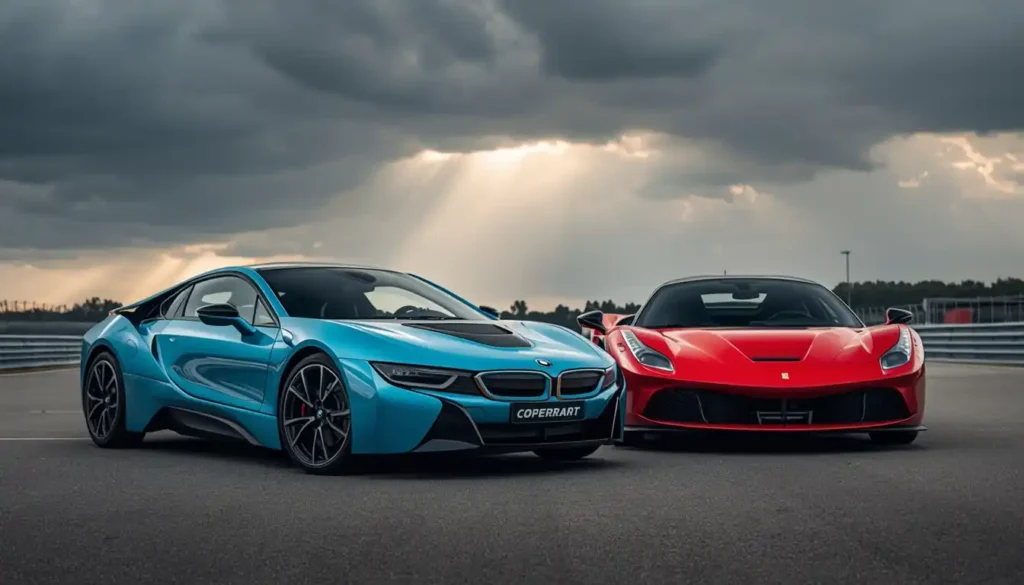
Every modern hybrid hypercar from the LaFerrari to the McLaren P1 uses the same fundamental concept that the BMW i8 pioneered at a fraction of the price. Top Gear named it the best car of the last 30 years in their 2023 special. That’s the real legacy of this car.
BMW i8 vs. What Else You Can Buy at the Same Price
At $50,000 to $70,000 today, the BMW i8 competes against some genuinely strong alternatives. A Porsche 718 Cayman S at that budget gives you more driving feedback and a naturally aspirated boxer engine.
An Audi R8 V10 from 2014-2016 delivers far more raw power. A Chevrolet Corvette C7 Z06 gives you American performance muscle at a lower price point. So why consider the BMW sports i8 at all?
If outright BMW performance is the priority, our BMW M5 review covers a different kind of fast.
Because none of those cars get 40-plus miles per gallon in mixed driving. You won’t find a carbon fiber chassis with true AWD through a hybrid system at that price anywhere else.
And that parking lot moment, where every head turns when the butterfly doors swing up, simply doesn’t happen in a Cayman or a Corvette. The plug in hybrid sports car segment that the i8 created is genuinely unique at this price point.
Cars like the VW Golf GTE and BMW 330e M Sport borrowed that same regenerative braking technology, but wrapped it in ordinary commuter bodies. The i8 was doing all of that inside a $148,000 supercar inspired machine while those cars were still on drawing boards.
Is the BMW i8 Worth Buying in 2026?
Here’s my take after going through MotorTrend’s pricing data, Car and Driver’s test results, EPA fuel economy documentation, and real owner accounts from across the U.S. The BMW i8 is worth buying in 2026 for a specific type of buyer.
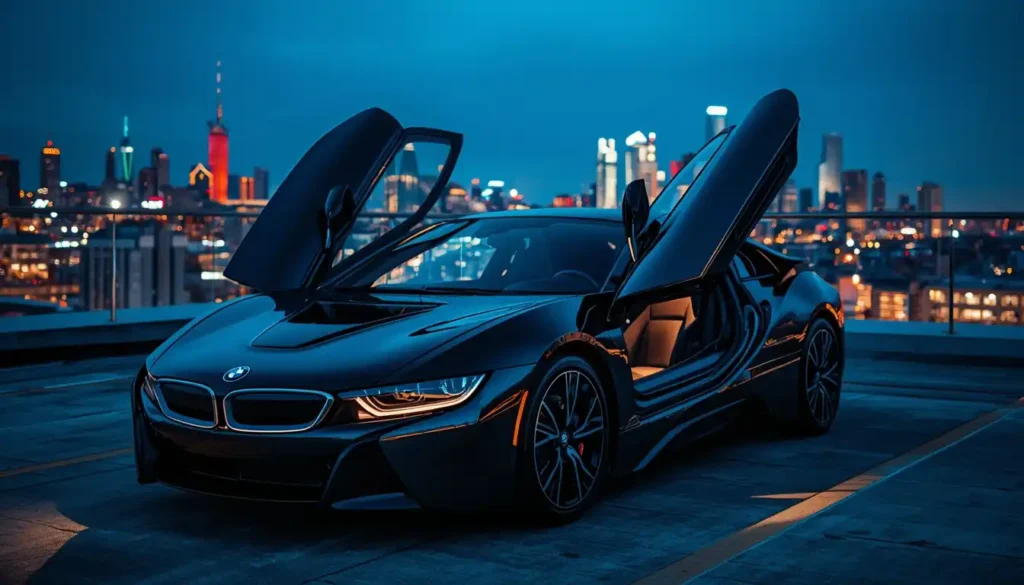
If you want a show stopping, CFRP-bodied sports car with those iconic upward-swinging doors and genuinely low annual running costs, and you’re willing to budget for occasional specialist maintenance, today’s BMW i8 price makes it genuinely compelling.
You’re getting a plug in hybrid all wheel drive sports car with supercar-level construction for the price of a loaded BMW 5 Series. “If you want BMW’s electric flagship instead of a sports car, check out our BMW i7 review.”
You should pass on it if you need daily practicality, want serious track performance, can’t access a BMW hybrid specialist within a reasonable drive, or are concerned about long-term parts availability over the next decade.
Cars like the VW Golf GTE and BMW 330e M Sport borrowed that same regenerative braking technology but wrapped it in ordinary commuter bodies.
The i8 was doing all of that inside a $148,000 supercar inspired machine while those cars were still on drawing boards. What BMW built from 2014 to 2020 is already moving toward future classic status.
Prices on clean, low mileage examples have been quietly climbing since 2023. Buying now, before the collector market fully wakes up to this car, might be the smartest move a used-car buyer makes this year.
Q: What is the BMW i8 price on the used market in the U.S. today?
A: A used BMW i8 in the U.S. currently sells for $40,000 to $75,000 depending on model year, mileage, and trim. Low mileage roadsters can exceed $90,000. Higher mileage 2014-2016 Coupes can be found at or below $45,000.
Q: What is the BMW i8 horsepower?
A: The 2018-2020 BMW i8 produces 369 combined hp from its gasoline and electric motors. Earlier 2014-2017 models delivered a combined 357 hp. Peak torque is 420 lb-ft in both generations.
Q: What is the BMW i8 0-60 time?
A: The Coupe does 0-60 mph in 4.2 seconds. The Roadster takes 4.4 seconds. MotorTrend recorded 3.8 seconds with launch control active in their independent testing.
Q: Is the BMW i8 a Hybrid or Fully Electric?
A: This question comes up constantly, and the short answer is neither fully electric nor traditionally hybrid. The BMW i8 is a plug-in hybrid sports car, which puts it in a separate category from both pure EVs and mild hybrids.
It carries a physical charging port, which means you plug it into a wall outlet or charging station to fill the 11.6 kWh battery. That battery alone powers the front electric motor for up to 18 miles of completely silent, zero-emission driving at speeds up to 75 mph.
Once the battery depletes, the 1.5-liter turbocharged three-cylinder engine at the rear takes over, and the car runs like any other petrol car. You never have to plug it in at all if you prefer not to. It just runs as a conventional sports car on gasoline.
What separates it from a standard hybrid like a Toyota Prius is the external charging capability and the sports car application. What separates it from a full EV like a Tesla Model 3 is the gasoline engine backup that eliminates range anxiety entirely.
For buyers coming from the EV world, think of it as a short-range EV with a petrol safety net. For buyers coming from the sports car world, think of it as a performance car that happens to run on electricity for your daily commute.
Q: Is the BMW i8 a fully electric car?
No. The BMW i8 is a plug in hybrid sports car, not a fully electric vehicle. It carries an 11.6 kWh battery (2018-2020) for 15 to 18 miles of electric-only driving, plus a 1.5-liter turbocharged gasoline engine for longer trips.
Q: What is the BMW i8 fuel economy in the U.S.?
A: EPA-rated at 69 MPGe in electric mode. Running on gasoline only after the battery depletes, expect 27 to 29 mpg combined. Real world highway mpg for the BMW i8 runs 30 to 35 mpg in typical U.S. driving conditions.
Q: Why was the BMW i8 discontinued?
A: BMW discontinued the i8 in 2020 because it sat between two markets without fully satisfying either. It was not efficient enough to compete with modern EVs on range and not powerful enough to beat established sports cars on performance. High carbon fiber construction costs played a role, too.
Q: What are the BMW i8 production years?
A: BMW produced the i8 from April 2014 through June 2020. The coupe ran the full production period. The Roadster was only available from 2019 to 2020, making it significantly rarer.
Q: Is the BMW i8 reliable for daily driving in the U.S.?
A: Generally, yes, with planning. Annual maintenance costs are low for a sports car. Main concerns for U.S. buyers include air conditioning repairs on older units, front suspension wear after 50,000 miles, and declining parts availability from BMW dealers since production ended.
Frequently Asked Questions About the BMW i8
Q: What is the BMW i8 price on the used market in the U.S. today?
A: A used BMW i8 in the U.S. currently sells for $40,000 to $75,000 depending on model year, mileage, and trim. Low mileage roadsters can exceed $90,000. Higher mileage 2014-2016 Coupes can be found at or below $45,000.
Q: What is the BMW i8 horsepower?
A: The 2018-2020 BMW i8 produces 369 combined hp from its gasoline and electric motors. Earlier 2014-2017 models delivered a combined 357 hp. Peak torque is 420 lb-ft in both generations.
Q: What is the BMW i8 0-60 time?
A: The Coupe does 0-60 mph in 4.2 seconds. The Roadster takes 4.4 seconds. MotorTrend recorded 3.8 seconds with launch control active in their independent testing.
Q: Is the BMW i8 a Hybrid or Fully Electric?
A: This question comes up constantly, and the short answer is neither fully electric nor traditionally hybrid. The BMW i8 is a plug-in hybrid sports car, which puts it in a separate category from both pure EVs and mild hybrids.
It carries a physical charging port, which means you plug it into a wall outlet or charging station to fill the 11.6 kWh battery. That battery alone powers the front electric motor for up to 18 miles of completely silent, zero-emission driving at speeds up to 75 mph.
Once the battery depletes, the 1.5-liter turbocharged three-cylinder engine at the rear takes over, and the car runs like any other petrol car. You never have to plug it in at all if you prefer not to. It just runs as a conventional sports car on gasoline.
What separates it from a standard hybrid like a Toyota Prius is the external charging capability and the sports car application. What separates it from a full EV like a Tesla Model 3 is the gasoline engine backup that eliminates range anxiety entirely.
For buyers coming from the EV world, think of it as a short-range EV with a petrol safety net. For buyers coming from the sports car world, think of it as a performance car that happens to run on electricity for your daily commute.
Q: Is the BMW i8 a fully electric car?
A: No. The BMW i8 is a plug in hybrid sports car, not a fully electric vehicle. It carries an 11.6 kWh battery (2018-2020) for 15 to 18 miles of electric-only driving, plus a 1.5-liter turbocharged gasoline engine for longer trips.
Q: What is the BMW i8 fuel economy in the U.S.?
A: EPA-rated at 69 MPGe in electric mode. Running on gasoline only after the battery depletes, expect 27 to 29 mpg combined. Real world highway mpg for the BMW i8 runs 30 to 35 mpg in typical U.S. driving conditions.
Q: Why was the BMW i8 discontinued?
A: BMW discontinued the i8 in 2020 because it sat between two markets without fully satisfying either. It was not efficient enough to compete with modern EVs on range and not powerful enough to beat established sports cars on performance. High carbon fiber construction costs played a role, too.
Q: What are the BMW i8 production years?
A: BMW produced the i8 from April 2014 through June 2020. The coupe ran the full production period. The Roadster was only available from 2019 to 2020, making it significantly rarer.
Q: Is the BMW i8 reliable for daily driving in the U.S.?
A: Generally, yes, with planning. Annual maintenance costs are low for a sports car. Main concerns for U.S. buyers include air conditioning repairs on older units, front suspension wear after 50,000 miles, and declining parts availability from BMW dealers since production ended.
Conclusion
The BMW i8 arrived in America before the country was ready for a hybrid sports car that looked like this and cost this much. It proved the concept worked, inspired every hybrid hypercar that followed, and then quietly left production just as those imitators started arriving.
At today’s used BMW i8 price, you’re not buying yesterday’s news. You’re getting supercar DNA, carbon fiber construction, and AWD hybrid engineering for the price of a luxury sedan.
Whether that trade off works for you depends entirely on what you want from a car. For the right buyer in the U.S., it remains one of the most interesting purchases on the market right now.
If you prefer a traditional petrol sports car from BMW, our BMW Z4 review covers everything you need to know.
