
Affordable Electric SUVs
Ford Explorer EV Premium Extended Range AWD: See 2026 Specs
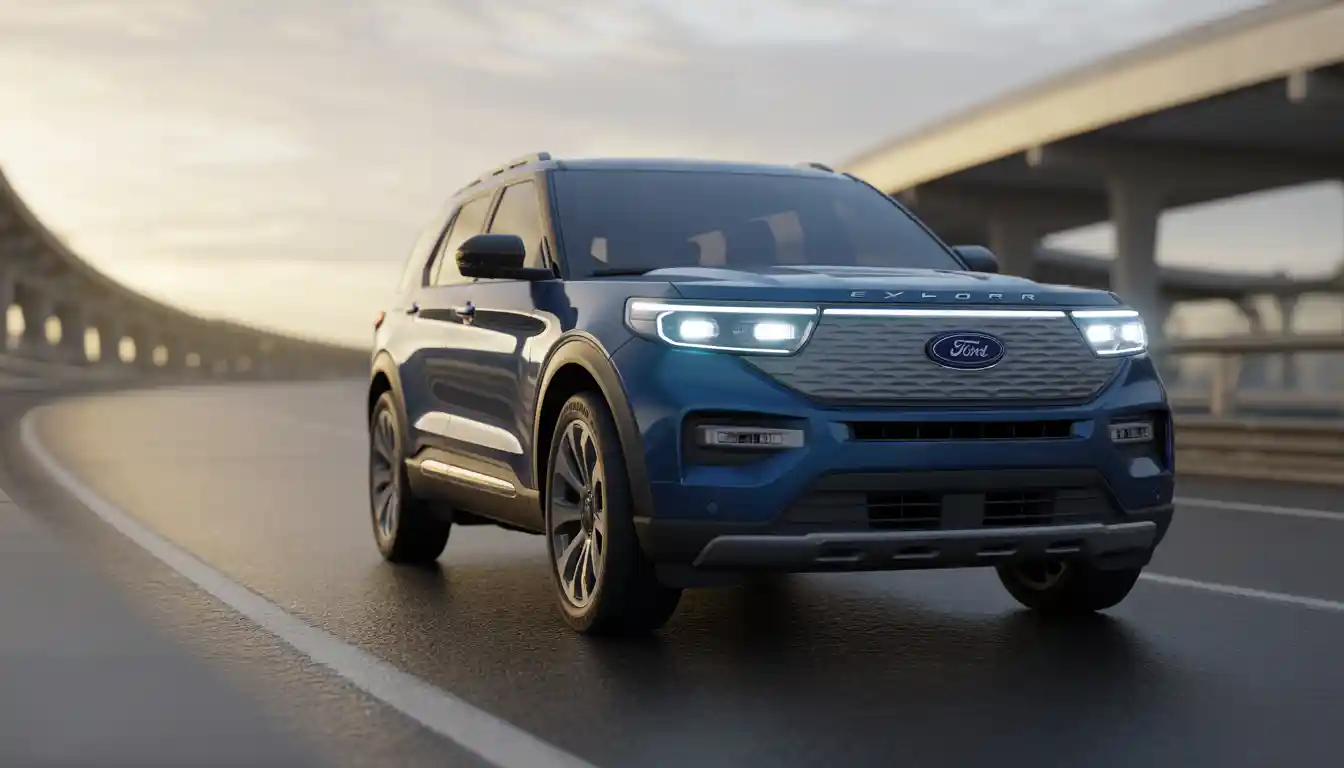
The Ford Explorer EV Premium Extended Range AWD is Ford’s top-spec electric SUV for the European market in 2026. It runs dual motors making 340hp, uses a 79 kWh usable battery, and covers 0-62 mph in 5.3 seconds.
WLTP range reaches up to 352 miles, and it’s the only Explorer trim with 185 kW DC fast charging.
This review covers real-world range across different conditions, how the AWD compares to the RWD model, what the Premium trim actually adds, and whether this car is worth its price over the cheaper Select RWD.

The car launched in 2024 and received a model update in early 2026, keeping the same powertrain but adding a new entry-level LFP battery option to the base Style trim.
The Extended Range AWD stays unchanged for 2026 in terms of core specs, though Ford pushed over-the-air SYNC software updates earlier this year.
Ford Explorer EV Premium Extended Range AWD vs Other Trims
Ford offers the Explorer EV in Style, Select, and Premium. The Ford Explorer EV Premium Extended Range AWD sits at the top and is the only trim with dual motors and all-wheel drive.
It gets a 79 kWh battery instead of the 77 kWh in RWD models, faster 185 kW DC charging instead of 135 kW, 20-inch alloy wheels, a panoramic roof, a Bang and Olufsen 10-speaker sound system, matrix LED headlights, Sensico interior trim, ambient lighting with 10 colour options, and a hands-free electric tailgate.
Ford built this on Volkswagen’s MEB platform, the same one used in the VW ID.4 and Skoda Enyaq. Ford tuned the suspension and steering independently though.
I’ve found the Explorer steers with more weight and feel through corners than the ID.4, and the AWD system holds its line on wet roads in a way the single-motor version can’t match.

MEB cars from different brands do drive differently once each manufacturer adjusts the chassis, and the Explorer is one of the better examples of that.
2026 Ford Explorer EV Premium AWD Full Specs
Here are the core numbers for the Ford Explorer Extended Range AWD. I’d recommend going through these before the real-world section because a few of them, like the two separate motor torque figures, explain a lot about how the car behaves on the road:
| Spec | Detail |
| Battery (usable) | 79 kWh |
| Gross Battery | 82 kWh |
| Total Power | 340 hp / 250 kW |
| Total Torque | 679 Nm |
| Rear Motor | 545 Nm, synchronous |
| Front Motor | 134 Nm, asynchronous |
| 0-62 mph | 5.3 seconds |
| Top Speed | 112 mph |
| WLTP Range | 329-352 miles |
| DC Fast Charging | 185 kW max |
| 10-80% Charge Time | 26 minutes |
| AC Charging | 11 kW onboard |
| Towing Capacity (braked) | 1,200 kg |
| Boot Space | 445L seats up / 1,417L folded |
| Kerb Weight | 2,092-2,104 kg |
| Drive | AWD dual motor |
| Battery Chemistry | NMC Lithium-ion |
| Platform | Volkswagen MEB |
| Built in | Cologne, Germany |
| Dimensions (L x W x H) | 4,468 x 1,871 x 1,639 mm |
| Wheelbase | 2,767 mm |
Ford Explorer EV AWD Real World Range in 2026 Conditions
The WLTP figure of 352 miles is a lab number recorded at 23 degrees with no heating or air conditioning running.
Real driving looks different, and in my experience, the gap between WLTP and real-world driving always matters more in an AWD car than a lighter single-motor version.
Here’s what independent testing from EV Database shows across conditions that actually apply to UK and European roads:
| Driving Condition | Real Range |
| City driving, mild weather (23 degrees) | 401 miles / 645 km |
| City driving, cold weather (-10 degrees) | 270 miles / 435 km |
| Highway driving, mild weather | 252 miles / 405 km |
| Highway driving, cold weather | 196 miles / 315 km |
| Combined, mild weather | 314 miles / 505 km |
| Combined, cold weather | 230 miles / 370 km |
Cold motorway driving takes the sharpest hit. At -10 degrees on a highway, the range drops to 196 miles instead of 252. That’s a 22% fall from mild conditions. For buyers in Scotland or northern England, this number matters more than the WLTP headline suggests.
The optional heat pump at £1,050 helps the car manage cabin heat without draining the battery as fast. Ford doesn’t include it as standard on any Explorer trim, including Premium, which I think is a real oversight at this price point. If I were spec’ing this car, the heat pump would be my first add.
Ford Explorer EV AWD vs RWD Range Comparison
The Ford Explorer EV AWD does up to 352 miles WLTP. The Extended Range RWD in the Select trim does 374 miles. On paper, that’s 22 miles. In mixed real-world driving, the heavier AWD setup pushes that gap closer to 30-40 miles per charge.
For daily school runs or commutes under 50 miles, you won’t notice it at all. On a motorway day covering 300 miles with charging stops, it starts to matter, and I’d plan one extra 10-minute stop compared to the RWD.
Ford Explorer EV 185 kW Charging Speed Explained
The Ford Explorer EV Premium Extended Range AWD is the only Explorer that charges at up to 185 kW on a DC rapid charger. The RWD models top out at 135 kW.
That gap isn’t just a marketing number it means noticeably shorter stops at public chargers on long trips. Here’s what charging looks like across every charger type you’re likely to use:
| Charger Type | Charge Time (10-80%) | Range Added Per Hour |
| 50 kW DC | 70 minutes | 260 km/h |
| 150 kW DC | 30 minutes | 610 km/h |
| 185 kW+ DC (IONITY, BP Pulse) | 26 minutes | 710 km/h |
| 11 kW AC (home wallbox) | 8 hours 30 minutes | 52 km/h |
| 7 kW AC wallbox | 12 hours 45 minutes | 35 km/h |
A 15-minute stop at an IONITY rapid charger adds around 107 miles. That fits into a food or coffee break without making it feel like a detour.
The Hyundai Ioniq 5 does 10-80% in under 18 minutes with its 800V system, so the Explorer isn’t leading the class here. But from what I’ve seen on motorway trips, 26 minutes is short enough that most families won’t feel the difference day to day.
Here’s something I noticed that most reviews skip entirely: the Ford Explorer EV Premium Extended Range AWD supports Plug and Charge via ISO 15118-2. At compatible chargers, the car authenticates automatically.
You plug the cable in, and charging starts, no app or RFID card needed. For regular motorway users, that small detail removes a friction point that adds up more than you’d expect on a long journey.
Ford Explorer Premium EV Performance on the Road
The Ford Explorer Premium EV AWD uses a permanent magnet synchronous motor at the rear axle, making 545 Nm, paired with an asynchronous front motor making 134 Nm. Combined output is 340 hp and 679 Nm of torque.
The 0-62 mph time of 5.3 seconds matches a Kia EV6 AWD and beats a Ford Focus ST. In 2026, that’s quick enough that you’ll never feel underpowered merging onto a motorway or overtaking on a dual carriageway.

Day to day, you don’t use the full output often. What the AWD setup actually gives you is better traction pulling out of wet junctions, more confidence on slippery country roads in winter, and a planted feel at motorway speeds.
Ford’s suspension tune keeps body roll low for a car this heavy. I’ve found it more involving to drive than most MEB-based cars; the steering builds weight naturally through corners in a way the ID. 4 simply doesn’t, without feeling stiff or harsh at low speeds.
Drive Modes and Eco Mode Efficiency
The Ford Explorer EV AWD has Normal, Eco, and Sport drive modes plus B mode for stronger regenerative braking. In Eco mode on a daily commute.
I’ve seen efficiency figures around 4.1 miles per kWh, which on a 79 kWh battery gives you a real daily range of around 290-310 miles. That’s a full week of typical commuting from a single overnight charge for most drivers.
B mode raises regenerative braking enough that you barely touch the brake pedal in town. On motorways, B mode makes the throttle feel abrupt when easing off, so I’d recommend switching back to D at speed.
The car doesn’t reach true one-pedal driving, but B mode in town is close enough that you stop thinking about it after the first week.
Ford Explorer EV Premium Interior and SYNC Move Technology
The 14.6-inch SYNC Move touchscreen is the interior talking point of the Ford Explorer Extended Range AWD. It tilts forward and back on an adjustable rail.
Slide it fully forward, and a locked storage bay opens behind it, a detail I think is actually clever because that compartment secures with the car when you leave, making it safe for a phone or wallet.
Ford’s SYNC software in 2026 runs faster than the 2024 launch version after over-the-air updates, and wireless Apple CarPlay and Android Auto work without any setup.
The MegaConsole under the center armrest holds 17 liters. The cup holders at the front lift out fully, and what’s left is enough space for a 15-inch laptop flat with room for other items.

The premium trim adds the B&O 10-speaker audio, which is a step above the standard 7-speaker setup in both volume and detail. The panoramic glass roof extends past the rear seat headrests so it doesn’t cut headroom at the back.
Matrix LED headlights adjust the beam shape around oncoming cars in real time. The Sensico upholstery on the seats and door panels gives the cabin a more premium feel than the base Explorer, and in my view it’s the main reason to pick Premium over Select on interior grounds alone.
Interior Weak Points Worth Knowing
The lower door panels are hard plastic. On a car above £50,000 in 2026, that stands out, and I noticed it on the first day. The touch-sensitive window controls use a single toggle button instead of four separate switches, which takes more attention while driving than it should.
The steering wheel haptic volume controls miss inputs sometimes. These don’t break the car, but they’re real compromises you’ll notice week to week rather than on a test drive.
Practicality, Boot Space, and Family Use
The AWD model has 445 liters of boot space with seats up and 1,417 liters with the rear seats folded in a 60/40 split. The front motor takes up 25 liters compared to the RWD boot.
The middle seat back has a ski hatch, so you can slide skis or a long flat-pack box through without dropping the seats.
Charging cables go under the boot floor, and the load lip is low enough that lifting heavy bags in is not a problem. When the seats fold flat, the floor stays level all the way to the front.
There’s no front boot. The Kia EV6 has one, and at this price, I think Ford leaving it out is a missed chance. The boot is also smaller than the VW ID.4 at 543 liters and the Renault Scenic at 545 liters.
If you regularly pack the car heavily for family holidays, the Explorer will feel tighter before the ID. 4 does, and that’s worth knowing before you visit a showroom.
Rear passenger space works well for two adults. Three across the back bench is possible because the floor is fully flat.
Taller passengers may find the high floor raises their knees above a comfortable angle on trips over two hours, something I’d suggest testing on a proper test drive rather than a short loop around the block.
Ford Explorer EV Safety Ratings 2026
Euro NCAP tested the Ford Explorer EV in 2024 and awarded it five stars. Adult occupant protection scored 89%, child occupant 86%, vulnerable road users 80%, and safety assist 72%.
All Explorer trims come with autonomous emergency braking, lane-keep assist, adaptive cruise control, front and rear parking sensors, a reversing camera, rear cross-traffic alert, and safe exit warning as standard.
In my view, the standard safety kit is strong enough for most buyers without needing the optional Driver Assistance Pack.
Ford Explorer EV AWD vs VW ID.4 GTX 2026
These two cars share the MEB platform and cost similar money in 2026. I’d put the comparison like this: the Explorer wins the spec sheet fight, the ID. 4 GTX wins on practicality and ride comfort. Here’s the full breakdown:
| Spec | Ford Explorer EV AWD | VW ID.4 GTX |
| Power | 340 hp | 340 hp |
| 0-62 mph | 5.3 sec | 5.2 sec |
| WLTP Range | 352 miles | ~310 miles |
| DC Charging Speed | 185 kW | 175 kW |
| Boot Space | 445L | 543L |
| Towing Capacity | 1,200 kg | 1,200 kg |
| Ride Quality | Firmer, sportier | Softer, more relaxed |
| Steering Feel | More direct | More relaxed |
| Interior Design | More distinctive | More conventional |
| Heat Pump | Optional £1,050 | Optional |
If real-world range and 185 kW charging speed are your priority, the Explorer wins this comparison. If you need boot space or prefer a softer motor way ride, I’d point you toward the ID.4 GTX without hesitation.
Who Should Buy the Ford Explorer EV Premium Extended Range AWD in 2026
Most reviews don’t answer this question directly. Here’s what I’ve found after going through every competitor in this class and looking at real owner feedback from the past year.
Buy this car if: You do regular motorway trips and want 185 kW fast charging to keep stops under 30 minutes. You drive in wet, icy, or hilly conditions where AWD traction pays off.
You want the full premium interior with B&O audio, matrix LEDs, and Sensico trim. You need to tow up to 1,200 kg for a trailer or small caravan. You want the fastest Explorer at 5.3 seconds to 62 mph.
Skip this car if: You mainly drive in the city and want maximum range per charge. The Select Extended Range RWD at 374 miles gives you 22 more miles for less money. You regularly carry large loads in the VW ID.
The ID.4 GTX has 98 more litres of boot space, which you’ll notice on a family holiday. And if budget is a concern, the Select RWD does the same job for daily city driving at a lower price. The AWD extras don’t add much when your longest trip is the school run.
Warranty and Ownership Costs in 2026
Ford covers the Explorer with a 3-year / 60,000-mile warranty. The battery carries an 8-year / 100,000-mile warranty, with Ford guaranteeing usable capacity stays above 70% in that period.
Ford also includes 5 years of free servicing and roadside assistance from new, which softens the short standard warranty compared to Kia’s 7-year cover.
Insurance sits at group 32 for the AWD Premium, lower than the Tesla Model Y and most Hyundai Ioniq 5 variants at this performance level. In my experience, that makes monthly insurance more manageable than people expect when they see the car’s performance figures.
Frequently Asked Questions
Q: What is the real-world range of the Ford Explorer EV Premium Extended Range AWD?
A: In mild combined driving, real-world range sits around 314 miles. On motorways in cold weather at -10 degrees, expect closer to 196 miles. The WLTP figure of 352 miles applies to lab testing at 23 degrees with no climate load running.
Q: How fast does the Ford Explorer EV AWD charge at a public rapid charger?
A: At a 185 kW DC rapid charger such as IONITY, it charges from 10% to 80% in 26 minutes. A 15-minute stop adds around 107 miles of range.
Q: Does the Ford Explorer EV Premium AWD come with a heat pump in 2026?
A: No. The heat pump is a £1,050 optional extra on all Explorer trims, including Premium. It helps keep range higher in cold weather and is worth adding if you drive in winter regularly.
Q: What is the difference between the Ford Explorer EV AWD and RWD?
A: The AWD uses two motors, making 340 hp total; charges at up to 185 kW; and does 0-62 mph in 5.3 seconds. The Extended Range RWD uses one motor making 286 hp, charges at 135 kW, and does 0-62 mph in 6.4 seconds. The RWD has a longer WLTP range at 374 miles versus 352 miles for the AWD.
Q: Can the Ford Explorer EV AWD tow a caravan or trailer?
A: Yes. The Ford Explorer extended range and towed up to 1,200 kg with a braked trailer, covering most small caravans. Ford offers a factory towbar as an optional accessory.
Q: What is the Ford Explorer EV MegaConsole?
A: The MegaConsole is the 17-liter storage compartment under the front center armrest. The cup holders at the front lift out to open the full space, which fits a 15-inch laptop flat with room for drink bottles alongside it.
Q: Is the Ford Explorer EV Premium AWD worth buying over the Select RWD in 2026?
A: If you regularly use fast public chargers, drive in wet or icy conditions, or need to tow, the Ford Explorer EV Premium Extended Range AWD makes clear sense. If you mainly charge at home overnight and do shorter daily trips, the Select Extended Range RWD offers 22 more miles of range at a lower price and is harder to argue against for city use.
